Pages

For People Crazy About 2D Animation!

Acme Punched! is for people crazy about 2D animation. It may be enjoyed by beginners and others, but it is aimed at animators who know already something about the process of animation and the basics of character animation. In large part, it will attempt to provide a deep look into the problem solving that goes on in my head as I work out a scene, often in step-by-step posts that I will sometimes enter in "real time", without knowing in advance what the outcome will be. Mistakes and false starts will not only be included but emphasized, so that the creative process of animation will be portrayed realistically. And, while my own bias is for 2D drawn animation, many of the effects and principles discussed here can apply to CGI 3D animation as well. I hope the blog will prove useful and instructive for all.

-Jim Bradrick

Wednesday, August 7, 2013

No. 47, Hollywood Cartoons: A Disney Cel Puzzle, Part 2

I have a little bit to add to my piece in No. 46 about Who Killed Cock Robin.

One objective is to give due credit to the great Disney animator, Ham Luske.  Like Norm Ferguson, Luske was an early star talent in the thirties, responsible for much of the groundbreaking character animation that came out of the studio as the art was developing into the complex and subtle medium that reached its apex with the Nine Old Men.  Ham Luske may be best known as the animator of Max Hare, the brash and arrogant athlete of The Tortoise and the Hare.  But he also did the seductive, spot-on Mae West caricature , Jenny Wren, in Who Killed Cock Robin.

Second, after publishing the previous post, I recalled that there was mention of the Pegleg Pete gag in The Illusion of Life, the exhaustive Disney studio history and text by Frank Thomas and Ollie Johnston.  I looked it up and found this reference on page 50.

Turns out, it doesn't always have to be a bully or a villain doing this, as Oswald was a protagonist in his films.
Here you see the same gag three times--in 1928 with Oswald Rabbit (before Mickey), and with Pete in 1934 and in 1940.  These in addition to the one we mentioned from Cock Robin.

How many more times might it have appeared?  Perhaps Jerry Beck knows the exact number, but I am sure there must be a dozen examples at least.  It has occurred to me that the gag might be based on the business of some popular vaudeville or silent film comedian, but I don't know.

Saturday, July 27, 2013

No. 46, Hollywood Cartoons: A Disney Cel Puzzle

Time out for a little fun that came my way the other day when I was contacted by a man named Wesley Miller.  Mr. Miller has an interesting collection of animation art:  it consists of cels or drawings of characters being hit over the head.  He had contacted me becuase of an episode of the sitcom King of Queens I worked on in which the main character goes to bed in a fever, leaving the television on; he keeps changing channels, and in his delirium sees himself and his family in various popular TV shows (Wheel of Fortiune, The Honeymooners), one of which is animated.  In each segment his deceptions are discovered by his wife, and in our animated piece she hits him over the head with a mallet, then a skillet, and finally a piano.

When I replied, he sent me a scan of one of his acquisitions, telling me only that it was a Disney cel.  Here it is:

I decided it would be fun to see how much I could deduce from the image, based on my own knowledge of the evolution of  Disney styles and practices.

First of all, the characters were unknown to me--probably one-offs that did not appear in any other cartoons.  Most likely, it was from a Silly Symphony.

Notice the peg holes at the bottom: there are 5 of them.  This confirmed that it was Disney, all right, as the system is similar to Acme punching in that the end holes are oblongs and the center hole round.  The second and forth holes are uniquely Disney: a system for archiving the cels in binders; in this way the binder rings do not deteriorate the registration holes.  However, at Disney the old registration system of just two round holes was used into the early 1930's, so this cel must have come from a production that came after that innovation.

My next clue was more subtle: the drawiing style.  There is a crudeness and casualness to the drawing that, to me, places this example in the early thirties.  By 1936 the whole studio had been transformed by drawing classes and by high-minded work on Snow White into a temple of deliberately stylish drawing, often influenced  by anatomical knowledge even in the case of the most cartoony characters.  The famous  Three Little Pigs of 1933, despite its fine animation and characterization, still contains much design of the old school of animation: circles for heads and bodies and some rubber-hose style limbs.  Notice in the cel, how the judge's hands are inconsistent in their rendering: on the right hand, the little finger is longer than the ring finger, and the thumb seems to be confused with what may be a button on his robe.  A year later, no such ambiguity would be permitted at Disney.  The left hand with the mallet is equally casual with its small thumb and uncertain grip on the handle of the mallet, the head of which is squashed unconvincingly.

Even though this scene may have been the work of a junior animator, by the late thirties the styling even of inbetweens was rigidly consistent throughout the studio.

So I told Mr. Miller that I thought his cel was from between 1934 and 1936, and most likely 1934.  And it was!  Turns out it is from the Silly Symphony Who Killed Cock Robin?, which is most famous for its Jenny Wren character, a marvelous caricature in styling and movement of the voluptuous actress Mae West.  Released in 1935, it was probably drawn in 1934.

On YouTube, with a little work, I managed to isolate the very frame of film that captures this cel.  Here it is:


Notice that the expanding white impact flash now stands out well against the painted background.  The blur lines that trail after the mallet, however, hardly can be seen.

If you would like to see the whole cartoon, here is a good link.

This cartoon is a good example of the old style being overtaken by the new.  Let's look at a few more examples of this.

The repeatable gag, not repeated.
In the silent and black and white cartoons, well into the thirties, a funny gag was repeated once, twice, even three times, in an effort to get more mileage and screen time out of the footage.  This may have also been in the belief that the audience liked the repitition, or didn't realize they were seeing the same thing over again, or was too stupid to appreciate it in just one viewing.  In the beginning, Disney cartoons were as guilty of this as Warner Bros or the Fleischers.  At any rate it was commonplace, and here was a gag with that potential: the ambulance is flying along, encounters a big tree, and must veer sharply to make it between the bows.  But to my amazement, they do it only once!  The Disney studio has learned some restraint.


The cloned character gimmick.
Here's another convention that goes way back at all the studios, another technique regarded as a saver of time and work:  animating a character once, then inking the drawings multiple times, each time with the image displaced on the screen so that there appear to be two or more characters--in this case, eight!--all moving in unison like Rockettes.  Ub Iwerks did it in The Skeleton Dance from 1929, and it even appears as late as 1976 in Richard Williams feature Raggedy Ann and Andy (some dancing dolls).

But again, times were a-changin'...
Seven cops, seven different movements.

In another scene, these Keystone Kops characters, while all exactly alike in design, are all moving independently.  Disney has learned the appeal of complex and diverse movement in their quest for the "illusion of life."


The stereotype of the simple and lazy black man.
Racial stereotypes are found in many cartoons of this period, and even way into the 50's  (how about the lazy Mexicans in Friz Freleng's Speedy Gonzalez cartoons?) and the Disney organization was no exception to the rule.  Here we have a slow-talking character in the mold of Stepin Fetchit, dressed as a sleeping car porter, being victimized by a cop with an Irish (!) accent.


The tough guy raises his belly up...
...then lets it drop in a gesture signifying the bravado of a bully.
Here's a peculiar old gag that goes back at least as far as Pegleg Pete in Steamboat Willie.  I may be wrong, but I think it is exclusively a Disney gesture.  It may be just a takeoff on someone ostentatiously hitching up his pants.

Pete in Steamboat Willie, 1928, before he got his peg leg.
Here's Pete at full lift before dropping his belly, seven years prior to to the character in Cock Robin.  Old gags die hard.

Mae West aka Jenny Wren.
And here is an image of the Jenny Wren character, a real tour-de-force of personality animation for its day .


Please let me know if you enjoy this kind of analysis of some of the old Hollywood animation.  If I get a good response, I will do more.
Thursday, July 11, 2013

No. 45, Jim on a Limb: One (Part 3)

Digging Deeper


Last time I determined that something had to happen before the man lowered the fox; I needed to show the man coming to the decision to do that: in short, I needed to show him thinking.

Here are the new key drawings.

The beginning pose.  The man still stares in shock.
Suddenly he realizes he must take charge.  He focuses and becomes serious.


He leans in close.  His hands, with the fox, have not moved out of position yet.


Now he looks up and makes eye contact with his wife.  Then he nods to her (not shown), indicating that he intends to start moving the fox.  Nervously, she nods agreement.

As an anticipation he raises his elbows.

He lowers the fox down.  It is still gripping her nose.

Having got this far, his expression now returns to one of puzzlement.  Why has the fox done this? What can he do now?
 Only the changes in the man are seen here, but in a scene this complex, there are many things that must be animated one at a time, each time passing through all the drawings and keeping each movement in sympathy with the others. 

The woman will have trouble keeping in step with the man, so her nose gets stretched out a bit at first, causing her some pain.  The fox, rather than just holding on, gives the woman's nose a good jerk as they start down, further adding to her discomfort.  Last, the fox's tail will be animated in movements that give expression to his moods, but not so as to distract from the more important movements.

Next: How it looks in pencil test.


Monday, July 1, 2013

No. 44, Jim on a Limb: One (Part 2)

First Animatic

Here is the animatic I created using mostly just the drawings posted in Part 1.  An attempt was made to suggest the timing of the entire segment.


I invited the Director (me) into my office to look at it with me on my computer.  He took one glance at the video, shook his head and started for the door.

"Well, what do you think?" I (the animator) called out.

He turned back to look at me.  "They both start moving at once," he said.  "How is anyone supposed to know what to look at?"  Then he was gone.

I was disappointed, but only in myself.  He was right.  I had ignored a basic rule of animation, one I keep having trouble with when considered in its broadest sense.

Anticipation as a prelude to a particular action for a character is something I know well, and tend to do pretty well.  Someone pitching a ball winds up first; the windup of a baseball pitcher is the most obvious and exagerrated anticipation that we find in real life.  Any forward movement benefits from a windup of some kind, even if it is just the slightest gesture in the opposite direction.

But let's not forget that one purpose of the anticipation is to bring the eyes of the audience to the right place in time to appreciate the main action.

When you have two characters on screen at once, this becomes doubly important, and so on.  You don't want a viewer studying the eyes of the secondary character when the main character is about to do something important.

So who is leading here, and who following?  It is the man leading; he wants to lower the fox down to a level where he will have more control.  As the woman is connected to the fox by its jaws, she must come down also.

Is an anticipation by the man all we need here?  No, I believe we need more.  We need to show the man thinking before we show him acting on his thoughts.


Next:  The Man Takes Charge


Saturday, June 22, 2013

No. 43, One Year of Acme Punched!


What if you could be Acme punched...literally?


Just a brief message to note that this blog has been running for over a year now; my first post was on May 13, 2012.  As of this writing I have had almost 5,400 page views, which I think is not bad for a blog of such specialized and arcane interest.  I have readers on all six inhabited continents and on most major island nations as well.

Some of the posts require a lot of preparation and work but I have been getting just enough encouragement to keep me going.  Doing the blog also helps me to keep focused on my personal film, The Crossing, which has grown to become so complex that I sometimes don't have any idea when it will be finished.

Anyway I will carry on.  Please keep coming back; I will try to get something new up at least twice a month, and often it will be more.  Your comments also are always encouraged.  (I have just changed some settings so that more people can comment now!)

Meantime, keep animating, and keep traditional animation alive!  The big distributors may think that they have killed traditional animation in feature films, but even if that were true, there remain many more intimate markets, and I believe that in drawn animation there exists a charm and allure that must not be allowed to fade away.

-Jim Bradrick

Monday, June 17, 2013

No. 42, Jim on a Limb: One (Part 1)

Jim on a Limb


This is the first of my posts in which I am attempting something difficult, a piece of animation not in the books, and where I am not completely sure of myself.  Plus, I am letting my readers see from the beginning most of my thoughts and all of my attempts to get it right. In the words of the Anglo-American expression, I am "out on a limb".  For me it will be an adventure, and I invite you to ride along with me.
 
Have I mentioned that animating pantomime is harder than animating dialog?  Oh, yes.

The uninitiated think that dialog makes animation more complicated, but in fact it affords the animator much in the way of guidelines and direction.  The actor's performance, if expert, sets up most of the timing, emphasis and emotion for the discerning animator.  The performance can inspire the animator to strong poses and expressions.With a scene that is entirely in pantomime, on the other hand, the animator is the only actor, and all timing and other nuances of the performance must come from within.

The scene I am involved with here concerns  three characters--the woman, the man and the fox--each of whom must be made to perform convincingly not just in isolation, but in relation to the other two.

And the section of that scene I am focused on now is the most difficult I have faced to date.

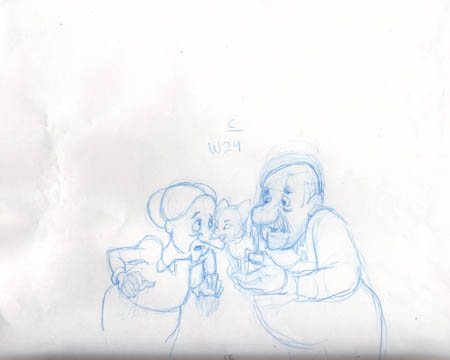
The fox, held in the hands of the man, has bitten the woman in the nose.  In shock and pain, she has pulled away, but the fox has held on, forcing the man to lift the fox up in order to ease the strain on the woman's nose.  She has stopped, and slowly she lowers her head as the man carefully lowers the fox.  The man then relaxes a little and straightens himself, his head rising up warily as he keeps his eyes on the fox.  The woman watches the man.  Then the man tilts his head for a better look at the fox.  The woman pulls herself into an attitude of supplication and, looking now at the fox,  attempts a forced smile.  They end the scene in stalemate.

Let's take a look at some rough key drawings made while working this out. 

Fig. 1.  This is the last frame of the action shot where she has just been bitten by the fox and has jerked away.
Fig 2.  This represents an extreme closeup that will last about 30 frames, or 1 1/4 seconds.
Fig. 3.  First frame as we cut back to the same framing as before.  The characters have settled into their poses (compare to fig. 1).
Fig. 4.  The man and woman, watching each other, carefully lower the fox back down.
Fig. 5.  They have come down as far as they will go.  Short hold.  The woman still watches the man, but he has moved his attention now to the fox.

Fig. 6.  The man drops his shoulders and straightens up,  He is now regarding the fox with alarm and confusion.  How could this little animal do such a thing?
Fig. 7.  He begins to lower his head again but stops, hesitant.
Fig. 8.  He lowers his head the rest of the way and peers at the fox; he is disappointed and bewildered.
Fig. 9.  Now the woman turns her attention from the man to the fox.  This is an anticipation.
Fig. 10.  Unsure what to do, she turns her head a little and gestures as if about to speak to a human.
Fig. 11.  Realizing that that is futile, she instead tries to smile at the fox (perhaps that will help!), and helplessly brings her fists together in supplication.

So there are the key drawings as I see them now.  As of this writing I have not worked out the exact timing.

Wish me luck!


Next: Timing and Spacing, and the First Animatic

Monday, June 10, 2013

No. 41, Drawing Problem 1: The Eccentric Breakdown Drawing (Part 3)

My Own Solution


Back in April I challenged my readers to create their own eccentric breakdown drawing  to go between two of my extremes.  [Here is the link.] I had one entry, and it was a good one.  Now I want to show you what my own breakdown looks like, as I have finally finished animating that part of the scene.

Here is the pencil test:

To begin with, I have to admit I changed one of the extremes--but it was only the head.  Testing an eary version of the pencils, I felt that the woman came too quickly out of her long hold and into action.  There is always the risk that it will not look good when all of a characters' parts begin moving at one time.  Also, I decided it would be good if she smiled before she moved, so that the smile will be noticed; remember that rule?  One thing at a time, if you want each thing to be noticed.  This little movement also ends with a moving hold of the head only.

So, she lowers her head and smiles, then goes into her pose, then ducks out of the way as the man brings the fox past her head.  Finally, she moves in to examine the fox closely.

If you were following the Drawing Challenge mentioned above, you may be interested to see  my version of drawing 65, the breakdown drawing: