Pages

For People Crazy About 2D Animation!

Acme Punched! is for people crazy about 2D animation. It may be enjoyed by beginners and others, but it is aimed at animators who know already something about the process of animation and the basics of character animation. In large part, it will attempt to provide a deep look into the problem solving that goes on in my head as I work out a scene, often in step-by-step posts that I will sometimes enter in "real time", without knowing in advance what the outcome will be. Mistakes and false starts will not only be included but emphasized, so that the creative process of animation will be portrayed realistically. And, while my own bias is for 2D drawn animation, many of the effects and principles discussed here can apply to CGI 3D animation as well. I hope the blog will prove useful and instructive for all.

-Jim Bradrick
Showing posts with label Jim-on-a Limb: One. Show all posts

Monday, January 13, 2014

No. 54, Jim on a Limb: One (Part 7)

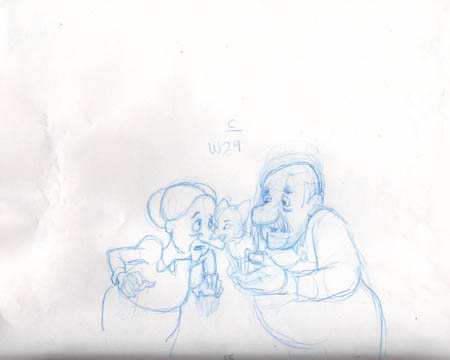
Here is a composite pencil test of a section--the most complicated section-- of this scene on which I have been working for the past few weeks.


I wish I could display it better but there is a limit to the number of layers you can effectively include in a single test, especially using blue pencil, as I do, for my roughs.  So, here and there I have turned some layers off to make it work.  (At times there are seven layers working!)  But you can see all the interaction going on among the woman, the man and the fox.

Not included are some character eyeblinks, which I will create during the inking process in Animate Pro, and the animation of the fox's tail.

I am at last satisfied with this difficult action, directing the viewer's attention in turn to each character as needed.

[For the whole story, see parts 1 through 6 of this 7-part post, which is also designated by the post numbers 42, 44, 45, 48, 49, 50 and 54, and which goes back all the way to June 17. ]

Sunday, November 17, 2013

No. 50, Jim on a Limb: One (Part 6)

Animating the scene shown and described in No. 49 was a matter of trial and error.  For the most part, the poses worked and it was just a matter of working out the timing.  For example, the two changes of expression (from despair to determination, then to cunning) were at first almost identical in their timing.  I realized then that coming one right after the other, they needed to be different from each other.
Despair to determination is now shorter in frames, and the hold at the end is also shorter, than both those things in the second transition, from determination to cunning.  The latter thus gets more stress, and fittingly becomes the more important.

Three expressions: despair, determination, cunning.


To view the difference in timing, go here.

One pose that had to be re-done was this one showing her slumped down in despair.  For this character I wanted to use that limp-wristed attitude that at one time was so common among women when their hands were idle, but my first try had produced a pose that did not quite express the despairing mood. 


Also, when I saw the test in animation, I didn't like the movement, which showed the forearms and hands pulling back up too far after dropping down. It did not express the intended attitude of resignation and despair.

I replaced that pose with the one shown below, and I damped the movement until it seemed just right.


But one thing did go as I had hoped, and I got it right first time out.  This is the final movement where she settles into her attitude of supplication; she is saying, "Give me a break!  What did I ever do to you?"  Her arms come up and she knocks her fists together three times, hunching up her shoulders.


When something like this does go right, it makes all the other struggles worthwhile.


Next: Jim on a Limb: One (Part 7)  Doing What Is Necessary

Sunday, November 10, 2013

No. 49, Jim on a Limb: One (Part 5)

Note: I have now numbered all my posts chronologically, in addition to having series and subject headings.  I think this will make it a little easier for me to refer back to previous posts, and for you to locate them, especially as the parts of  series are are not always consecutive.


The Pencil Test


Here is the pencil test of Victoria as promised in my last post.  Remember that the fox has her firmly by the nose throughout this scene.  I have not included that layer of the fox only because using too many layers in a pencil test makes for a dark and murky image that you may have trouble viewiing.

[movie]

It works pretty well now, but as in most complex things that one tries to plan in advance, there were some changes along the way.


Changes to the Plan


First, two new extreme poses were added.  They fall between poses E and F as shown in Part 4.  Here are those poses again, with the new ones placed inbetween.

Pose E
Pose E expresses her feeling of despair.


Pose E-1
The first new pose, call it E-1, shows her stubborn nature returning; she will not be defeated!


Pose E-2
The second new pose, E-2, is a cunning expression; she has an idea and she is calculating whether it will persuade the fox.


Now we go to pose F and then G, where she gathers herself and then adopts an attitude of pleading or supplication.


Pose F

Pose G

Thus we have her thinking her problem through in a way that the viewer can easily follow.  This is the sort of deep exposition that I am just now learning to do, and which I have often failed to understand in the past, largely because my experience in professional animation has been mostly confined to commercials of 30 seconds or less, with no time and frames to spare for looking into a character's motivations and thought process.


In Part 6, I'll talk about how the animation itself went on this little scene.

Next: What Came Easy, and What Was Hard


Friday, October 25, 2013

No. 48, Jim on a Limb: One (Part 4)

Six weeks since I have posted.  Partly it was this and that, an illustration job, a couple of commercial jobs, the re-designing of my website, a busy late summer.  But also it was the difficulty of the problem here--the one I last mentioned in post no. 45, Jim on a Limb: One (Part 3)--in which I laid down the key drawings I needed to animate.  If you want to follow the continuity of this demonstration, please go back now and look at that post.

How It Looks in Pencil Test


Here is the result:

Of course this test is focused on the man.  His name is Albert.  I also have animation of the woman  about ready (her name is Victoria), but because too many layers make the pencil test dark and difficult to follow, I have left off all layers here except for two: Albert, and Albert's Head.

This is about what I wanted it to be in so far as Albert is concerned.  I think you can see him thinking.  He gets serious and cautious at the beginning, he communicates his plan to Victoria, and when he gets bumped in the nose by the fox as he lowers him down, Albert doesn't let it bother him much.  One thing I will make more clear is Albert's expression, which will remain disapproving until, at the end, he relaxes his stern expression to gaze in perplexity at the fox, who is behaving so badly.

Next it is Victoria who will try to deal with the fox, first as if to make some argument, then feeling hopeless, and finally just appealing to his good nature.  And all without a word of dialog or narration.

I have begun by adding a few more key drawings to define Victoria's performance; the first ones would be sufficient for a storyboard, but the animator must go further and think of everything that will be in the character's performance.

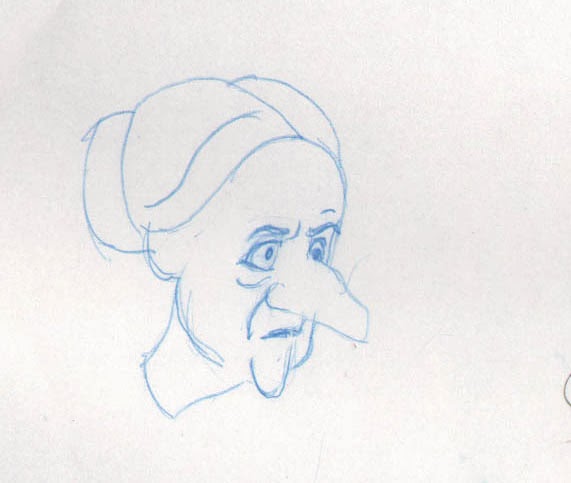
Victoria regards the stubborn fox.
Pose A is the last pose of the pencil test above.

She resolves to try something to make the fox let go.


Pose B shows her determination to act.  It also is an anticipation to Pose C.

She moves as if to speak out loud to the fox...
Pose C.  She might be about to actually say, "Why won't you let me go?"

...but stops short, realizing the futility of this.
Pose D pulls back a little from Pose C.  She holds for 16 frames, blinks.

Victoria slumps, feeling the situation as hopeless.
Pose E  expresses her feeling of despair.

An anticipation to pose G.
In Pose F, Victoria gathers herself for one last attempt.

The last pose: with her eyes she pleads for the fox's mercy.
Pose G shows her final supplication as she bats her eyelids and beats her fists together.

This is a tough bit to do because it is designed so that the character can barely move her head; where the fox grips her by the nose is a pivot point and anchor for the whole character, and the animator must work only with her expression, with her arms and hands, and with some cautious movement of her shoulders and body.


Next: Victoria and the Fox: the Pencil Test

Thursday, July 11, 2013

No. 45, Jim on a Limb: One (Part 3)

Digging Deeper


Last time I determined that something had to happen before the man lowered the fox; I needed to show the man coming to the decision to do that: in short, I needed to show him thinking.

Here are the new key drawings.

The beginning pose.  The man still stares in shock.
Suddenly he realizes he must take charge.  He focuses and becomes serious.


He leans in close.  His hands, with the fox, have not moved out of position yet.


Now he looks up and makes eye contact with his wife.  Then he nods to her (not shown), indicating that he intends to start moving the fox.  Nervously, she nods agreement.

As an anticipation he raises his elbows.

He lowers the fox down.  It is still gripping her nose.

Having got this far, his expression now returns to one of puzzlement.  Why has the fox done this? What can he do now?
 Only the changes in the man are seen here, but in a scene this complex, there are many things that must be animated one at a time, each time passing through all the drawings and keeping each movement in sympathy with the others. 

The woman will have trouble keeping in step with the man, so her nose gets stretched out a bit at first, causing her some pain.  The fox, rather than just holding on, gives the woman's nose a good jerk as they start down, further adding to her discomfort.  Last, the fox's tail will be animated in movements that give expression to his moods, but not so as to distract from the more important movements.

Next: How it looks in pencil test.


Monday, July 1, 2013

No. 44, Jim on a Limb: One (Part 2)

First Animatic

Here is the animatic I created using mostly just the drawings posted in Part 1.  An attempt was made to suggest the timing of the entire segment.


I invited the Director (me) into my office to look at it with me on my computer.  He took one glance at the video, shook his head and started for the door.

"Well, what do you think?" I (the animator) called out.

He turned back to look at me.  "They both start moving at once," he said.  "How is anyone supposed to know what to look at?"  Then he was gone.

I was disappointed, but only in myself.  He was right.  I had ignored a basic rule of animation, one I keep having trouble with when considered in its broadest sense.

Anticipation as a prelude to a particular action for a character is something I know well, and tend to do pretty well.  Someone pitching a ball winds up first; the windup of a baseball pitcher is the most obvious and exagerrated anticipation that we find in real life.  Any forward movement benefits from a windup of some kind, even if it is just the slightest gesture in the opposite direction.

But let's not forget that one purpose of the anticipation is to bring the eyes of the audience to the right place in time to appreciate the main action.

When you have two characters on screen at once, this becomes doubly important, and so on.  You don't want a viewer studying the eyes of the secondary character when the main character is about to do something important.

So who is leading here, and who following?  It is the man leading; he wants to lower the fox down to a level where he will have more control.  As the woman is connected to the fox by its jaws, she must come down also.

Is an anticipation by the man all we need here?  No, I believe we need more.  We need to show the man thinking before we show him acting on his thoughts.


Next:  The Man Takes Charge


Monday, June 17, 2013

No. 42, Jim on a Limb: One (Part 1)

Jim on a Limb


This is the first of my posts in which I am attempting something difficult, a piece of animation not in the books, and where I am not completely sure of myself.  Plus, I am letting my readers see from the beginning most of my thoughts and all of my attempts to get it right. In the words of the Anglo-American expression, I am "out on a limb".  For me it will be an adventure, and I invite you to ride along with me.
 
Have I mentioned that animating pantomime is harder than animating dialog?  Oh, yes.

The uninitiated think that dialog makes animation more complicated, but in fact it affords the animator much in the way of guidelines and direction.  The actor's performance, if expert, sets up most of the timing, emphasis and emotion for the discerning animator.  The performance can inspire the animator to strong poses and expressions.With a scene that is entirely in pantomime, on the other hand, the animator is the only actor, and all timing and other nuances of the performance must come from within.

The scene I am involved with here concerns  three characters--the woman, the man and the fox--each of whom must be made to perform convincingly not just in isolation, but in relation to the other two.

And the section of that scene I am focused on now is the most difficult I have faced to date.

The fox, held in the hands of the man, has bitten the woman in the nose.  In shock and pain, she has pulled away, but the fox has held on, forcing the man to lift the fox up in order to ease the strain on the woman's nose.  She has stopped, and slowly she lowers her head as the man carefully lowers the fox.  The man then relaxes a little and straightens himself, his head rising up warily as he keeps his eyes on the fox.  The woman watches the man.  Then the man tilts his head for a better look at the fox.  The woman pulls herself into an attitude of supplication and, looking now at the fox,  attempts a forced smile.  They end the scene in stalemate.

Let's take a look at some rough key drawings made while working this out. 

Fig. 1.  This is the last frame of the action shot where she has just been bitten by the fox and has jerked away.
Fig 2.  This represents an extreme closeup that will last about 30 frames, or 1 1/4 seconds.
Fig. 3.  First frame as we cut back to the same framing as before.  The characters have settled into their poses (compare to fig. 1).
Fig. 4.  The man and woman, watching each other, carefully lower the fox back down.
Fig. 5.  They have come down as far as they will go.  Short hold.  The woman still watches the man, but he has moved his attention now to the fox.

Fig. 6.  The man drops his shoulders and straightens up,  He is now regarding the fox with alarm and confusion.  How could this little animal do such a thing?
Fig. 7.  He begins to lower his head again but stops, hesitant.
Fig. 8.  He lowers his head the rest of the way and peers at the fox; he is disappointed and bewildered.
Fig. 9.  Now the woman turns her attention from the man to the fox.  This is an anticipation.
Fig. 10.  Unsure what to do, she turns her head a little and gestures as if about to speak to a human.
Fig. 11.  Realizing that that is futile, she instead tries to smile at the fox (perhaps that will help!), and helplessly brings her fists together in supplication.

So there are the key drawings as I see them now.  As of this writing I have not worked out the exact timing.

Wish me luck!


Next: Timing and Spacing, and the First Animatic