Pages

For People Crazy About 2D Animation!

Acme Punched! is for people crazy about 2D animation. It may be enjoyed by beginners and others, but it is aimed at animators who know already something about the process of animation and the basics of character animation. In large part, it will attempt to provide a deep look into the problem solving that goes on in my head as I work out a scene, often in step-by-step posts that I will sometimes enter in "real time", without knowing in advance what the outcome will be. Mistakes and false starts will not only be included but emphasized, so that the creative process of animation will be portrayed realistically. And, while my own bias is for 2D drawn animation, many of the effects and principles discussed here can apply to CGI 3D animation as well. I hope the blog will prove useful and instructive for all.

-Jim Bradrick
Showing posts with label Principles of Animation. Show all posts

Wednesday, November 18, 2015

No. 81, Book Review: The Nine Old Men, by Andreas Deja.


By the beginning of Franklin Roosevelt's second term as President in 1937, he had begun to call the U.S. Supreme Court justices of the time "the nine old men" for their obstructive attitude toward his social policies and programs.  It became his aim to try to replace six of their number in order to get a court more friendly and supportive of his attempts to bolster the economy.

Roosevelt failed in that, but the phrase Nine Old Men was picked up by Walt Disney and applied to his crew of senior animators, who just happened to be nine in number. Who were these men? Among other things, they were all animators who had stayed on Walt's side during the studio's labor troubles of the early 1940s. All nine were born between 1907 and 1914, and all but one started at the Disney studio in the early to mid thirties when intensive hiring and training were ramping up for the move into feature animation. (The exception was Les Clark, who began in 1927 at the age of 20, which made him the only one to arrive before both sound and color came to the movies). None of these young men except Clark had animation experience, and Clark had to retrain himself now to keep up with the sophisticated design and animation that was in development; the old rubber hose limbs and often crude drawing of the silent days were obsolete.
Les Clark learned to animate very well indeed.  From Symphony Hour, 1942.


In the new book by Andreas Deja, The Nine Old Men (392 pages, CRC Press, 2015), these animators are spotlighted and compared with one another in their strengths and styles from the personal viewpoint of the author, a brilliant animator in his own right who knew many of them and who actually trained under Eric Larson, best known for his animation of the sultry dog Peg in Lady and the Tramp.

Larson didn't do only animals.  Here, from Peter Pan, Wendy fails at her first attempt to leap into flight. Now she crouches for a second attempt.


As in John Canemaker's 2001 book of a similar title, Deja's book is divided into nine sections, each devoted to one animator. But the new book, subtitled Lessons, Techniques and Inspiration from Disney's Great Animators, is all about the drawing and the animation, with shorter illustrated biographies that detail each man's development at the studio from novice to mature artist. The latter part of each chapter is comprised of sequences of key animation drawings from important work along the career arc of the artist.

If you want to get as close as you can to the work of a master animator, there is nothing short of being inside the man's head that is better than to look at his pencil animation. I have always treasured reproductions of animation pencil drawings, and there have been some good collections.  Examples in the past include the oversized Treasures of Disney Animation Art (Abbeville Press, 1982) and The Walt Disney Studios Archive Series volume on Animation (Disney Editions, 2009). Both of these are made up of color reproductions (even of mostly black and white drawings!) that have been printed the actual size of the originals. Wonderful to look at, but limited in the amount of material that can be covered in a single volume.  And the otherwise terrific Illusion of Life, written by Frank Thomas and Ollie Johnston (Abbeville Press, 1981), though considered an essential bible by most of us who love drawn animation, contains numerous animation sequences that are disappointing on the page, each image in a stark black and white that illustrates the action without displaying the subtleties of the artist's drawing.

Frank Thomas, a Nine Old Man and co-author of Disney Animation: The Illusion of Life, does Merryweather the fairy, from Sleeping Beauty, 1959.


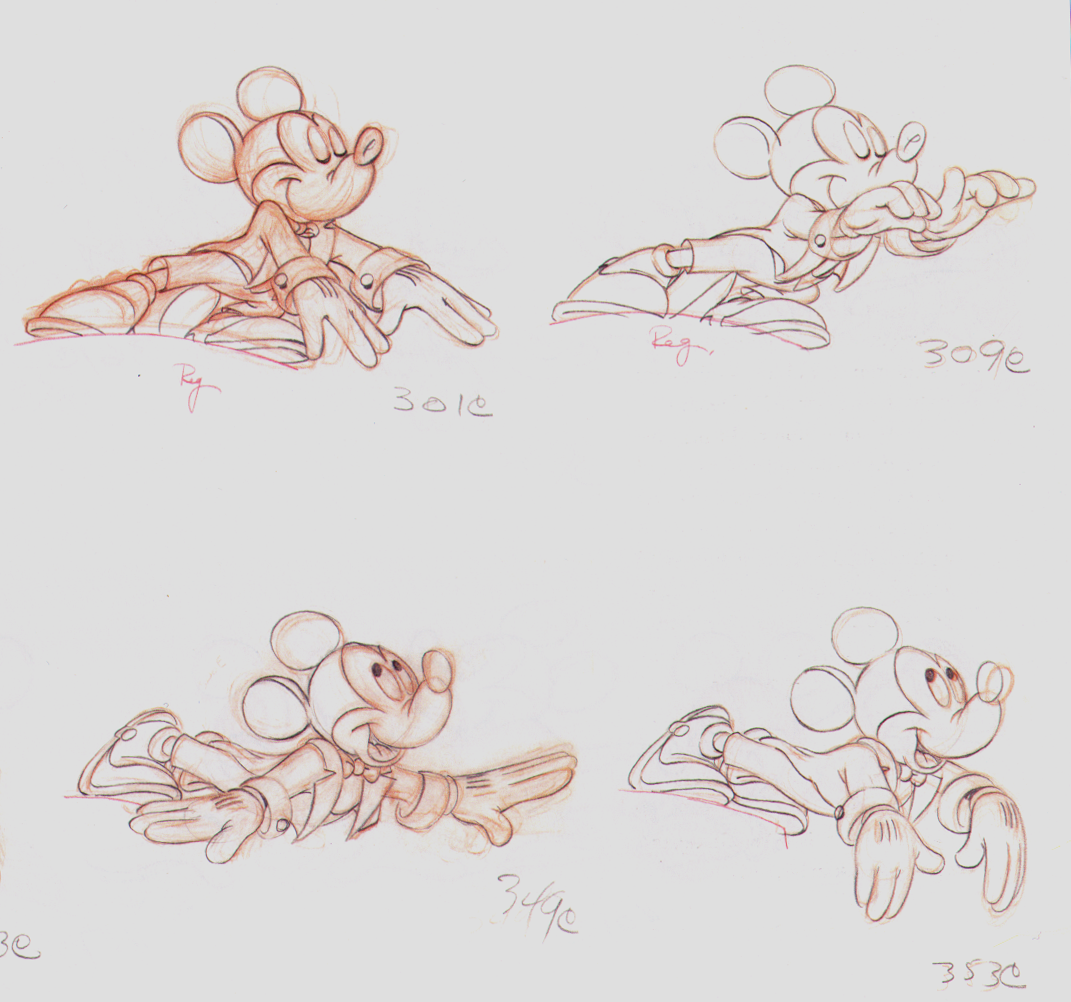
Andreas Deja and his publishers have found a happy medium,  reproducing in color all the pencil lines, because those lines were not only black or grey; a single drawing might also include pencil lines in blue or red--sometimes even green and ochre! The multiple colors were used for roughing in or for indicating match lines or other cues for those who would ink the drawings onto cels. As a bonus, almost all the drawings in the sequence sections include the original drawing numbers written on the sheets by the animators.  The serious student of animation can deduce much about the timing of the scenes from these notations.  Seldom included here, alas, are spacing guides, which can be even more revealing.

A Woolie Reitherman drawing from the El Gaucho Goofy segment of Saludos Amigos, 1943. Note the use of multiple colors of pencil.  Note also this amazing action drawing by Woolie!


Though not the only good animators at the studio, the Nine were all excellent, they had the all-important support and respect of Walt Disney, himself, and they got the cream of the important scenes to animate.  Eventually they mostly became supervising animators, mentoring younger animators such as Andreas Deja, Glen Keane, and many others who were to succeed them when they retired.

Two frames of Smee from Peter Pan, by Ollie Johnston, who was known for his light touch, sensitive emotional interpretations, and speed.  Johnston is the other co-author of Illusion of Life.


Deja has the advantage over other Disney historians in that he lived the life, producing in his own right numerous memorable animated performances such as villains Gaston, Scar and Jafar, and the comic hero Hercules. His insights about these men and their work are keen, and his own unflagging enthusiasm for his subject shines through.

Somewhat amazing is the wide variety of personalities and temperaments among these men who, nevertheless, were all able to sit and perform these feats of acting and creation at their drawing desks. Several, despite their differences, had the discipline and versatility to follow each other's lead in design and animation on a character, so that they could provide sequences of their own that integrated seamlessly with the other man's work.

John Lounsbery could even capture the style of Milt Kahl, and he could define his own characters, too.  Here, John's character Ali Gator, from the Dance of the Hours sequence of Fantasia, 1941.

Ward Kimball managed to get through his Disney career without once having to animate a realistic character like a prince or princess.  He liked it that way, but he was amazingly innovative both as a designer and in staging his scenes.  Here are some wonderful Kimball roughs from the Peter and the Wolf segment of Make Mine Music, 1946. 

Milt Kahl, because of his wonderful draftsmanship, did more princes  than anyone, but he enjoyed the cartoony stuff as well.  Here is the eponymous star of Pinocchio, 1940, as he finds himself turning into a donkey on Pleasure Island.


Marc Davis, creator of Flower the skunk in Bambi, 1942, and two immortal female villains, Maleficent in Sleeping Beauty, 1959, and, shown here, Cruella DeVil from 101 Dalmations, 1961. Davis then became a principal designer for attractions at the Disney theme parks.

Any student or practitioner of 2D animation should certainly have this book for both inspiration and study, and 3D animators and designers could also learn from it.  These are the very men who discovered and perfected what are now known as the 12 Principles of Animation.  The Nine Old Men are all gone now, but they have much yet to teach us.

All images copyright Disney.

Wednesday, April 23, 2014

No. 62, A Walk Cycle for Albert, Part Five: Side View

 Solution to "Mystery Change"


In the last post (No. 61), I challenged you to find a difference in timing between the two versions of the walk cycle.  No one took me up on it, and I admit it was a subtle detail to find amid everything else that was going on in the cycle.  But the answer is: I changed the timing of the right arm (the one holding the bag).  In version 1, as the bag comes forward and then reverses direction to recede again, the movement seemed to me to have a stabbing aspect to it; that is, it took no time and no effort to reverse direction.  I thought this was inappropriate for a bag that might weigh 100 pounds or 45 kilograms.

I therefore took a look at the spacing of the drawings.  As the bag comes forward, it has an appropriate cushion-in.  The chart below shows the relative positions of the seam at the front of the bag.


But as the bag reverses direction, the drawings were not spaced so as to give a good impression of the cushion-out (the spacing that indicates that an object starts out slowly and accelerates.)  The next chart shows both the old and the improved spacings.  Again, it is the seam on the bag that we are following.
The original spacing is shown in red, on the left.  Final spacing on the right.
I think if you will now go back to post no. 61 and carefully compare the two versions, you will observe more of a slow-down and hesitation between the forward and backward movements of the bag.  It is more like the compression and release of a spring, as it should be, rather than like something bouncing.


Translating to the Side View

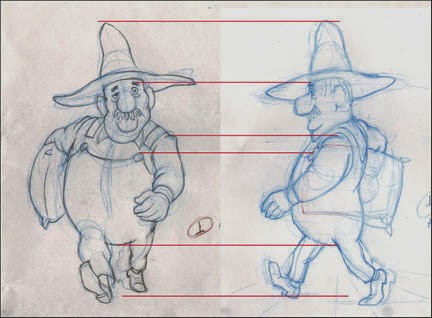
The obvious way to begin this translation of view is to construct the first image over the corresponding one of the other.  On my drawing board, that looks like this:
The front view showing through on my backlighted animation disk.
In a case like this, which is just a rotation on the Y axis, as the 3D-ers would think of it, many measurements can be directly applied from one drawing to the other.

Here are the two images separated, with a few points of congruence highlighted:
Showing where the top of the hat, the eyebrow, the shoulder seam, the top of the button and the bottom of the body mass coincide in both drawings.
Some things, of course, require adjustment.  Mainly these are the parts that project forward or backward in imagined space from the plane of the torso.  Thus the left hand appears larger in the front view to create the illusion that it is closer to the viewer, and the left foot is drawn smaller to show that it is farther back.

It should be emphasized that a walk cycle--or any animation, for that matter--should be designed with the perspective of its layout or background in mind; note the converging lines like floorboards on the drawing at right above, indicating the plane upon which the character is walking.  If you animate something without regard for the perspective and scale of the layout, you may be wasting time and work.  This should be considered even if creating something such as a gif animation meant to occupy the featureless expanse of a webpage.

Creating other angles wherein the viewpoint is raised or lowered is also possible, but here more sophisticated drawing skills are required to extrapolate from one to the other.
The same pose from a high angle, 3/4-front view.
I once was called upon to animate a character running while the camera swooped all about him--something a 3D animator of today would, admittedly, be able to do easily.  Yet once I had done a version of his run cycle from one viewpoint, I was able to work out all the other angles, and the whole thing worked very well.

Here is the first pencil test of the side view walk cycle:
I thought it worked pretty well, and it was fun to watch, yet something was not quite right for the walk of a man traveling a great distance.  Finally I decided that his stride was a bit too long; he is reaching a bit too far with each step.

So I shortened his stride by this much:
The erased images in red brackets show the original reach of his stride.
Here is the second test, incorporating the somewhat shorter stride along with a few other adjustments to the foot and leg positions in all the drawings:

I like this second version; except for details and cleanup, I am calling it done.

Your comments and questions are always welcome, and if you like what I am doing here, why not click on the Join This Site button and become a Follower?  That way you won't miss any posts, and I promise you many more to come!


Coming soon: Walks for Albert's Companions, a Fox and a Goose--two short-legged characters who must keep up with Albert's rapid pace!

Thursday, April 10, 2014

No. 61, A Walk Cycle for Albert, Part Four: Front View Final

I am going to present two versions of Albert's walk made this past week.  The first is about half cleaned up, with not all of my planned changes yet done.  The second is the final cleanup.  Later in this post, I will explain why I am including the half-finished version as well as the final.
The half-finished version. Here, some of the drawings are still in blue pencil but most of the planned changes are in.

This is the final pencil test; the drawings are all done in graphite pencil now and are ready to be scanned for digital ink-and-paint.

Cheap Trick Department:
When doing cycles such as this, one is constantly comparing the first half of the cycle with the other half; otherwise, the movement will not look balanced. In this case, drawing 1 (the right foot contact drawing) is more-or-less a mirror image of drawing 15 (the left foot contact drawing.)  Thus, each drawing in the cycle has its mirror counterpart.  With 14 drawings to track in this way, I have found it useful to give the drawings an alphabetic designation as well as its numeric one.  So drawings 1 and 15 are both also "A"; drawings 3 and 17 are both "B", and so on.  In this way it is easy to pull out both the drawings marked C or D or whatever for comparision to one another.

Changes made since the version shown in Post No. 60:
--More change of scale front to back.  That is, when Albert's foot or hand is closer to the camera, it is more obviously larger than when it is at the back, farthest from the camera.  This change of scale in what 3D animators call the Z axis can add depth and drama to a scene, even when the character's body remains a constant distance from the camera.  Opportunities to utilize this enhancement should not be neglected.

--Left arm animation.  As mentioned in No. 60, I was unhappy with the arc of the arm as it came forward.  This has been fixed.

--Shorter pants legs, with socks showing.  Shown only in the final.  Albert's socks are red, so there will be an amusing flash of color there.  Also I am simply complying with my own model sheets for Albert, bringing him on model.  The pants legs also are animated as a follow-through to the leg movement but this is rather subtle.

--Precise drawing.  Cleaning up the images in the same order in which they were drawn as roughs (extremes, then breakdowns, then inbetweens), everything has been tightened up.

--Foot slippage.  This could come under the heading of precise drawing, above, but in walk or run cycles it rates its own category.
Foot Slippage chart on drawing 17.
In doing the rough animation, I had just "eyeballed" the foot positions, but when it came time to clean the drawings up, I scrutinized them closely and found it useful to make this chart.  The lines represent the back of the heel on drawings where they are in contact with the ground.  Note the ghost images showing where the feet originally were in this drawing.

--Mystery Change ???  There is one other change I made here, and I challenge you to find it by comparing the Half-Finished and Final pencil tests above.  No new drawings were added, but something I haven't mentioned has been re-timed.

Can you find it?  I will post the answer next time, but I would like to hear from anyone who can find the change.  Moreover, can anyone tell me why I made this change?


Next: We Rotate Albert 90 Degrees and See His Walk from the Side.

Wednesday, April 2, 2014

No. 60, A Walk Cycle for Albert, Part Three: The Full Test

In addition to filling in all drawings for this walk cycle, this week I have improved the readability of these pencil tests.  Because I often do my rough drawings in blue pencil, the tests done in Toki Line Test software have been of such a low contrast that by the time they have been rendered as Quicktime Movies, they are hard to see, especially if there are multiple levels.  Now I have greatly improved this by exporting the drawings from Toki as jpegs, then adjusting their values in Photoshop before importing them once again into Toki Line Test.  I think you will appreciate the sharper, more high contrast result.

This test is now working in most ways.  A good walk cycle includes many details of movement besides just moving the feet and legs and swinging the arms. Here are some things I included in Albert's walk:

Rhythmic vertical movement. Does the character rise up or drop down on the passing positions, and by how much?  I have Albert rising up enough to be noticeable.

Shoulder action.  Albert's upper torso rotates in opposition to his hips, but his right shoulder is kept highest at all times because of the load he is carrying on that side.

The legs and feet.  They are working well.  Just before each of the contact drawings I inserted a little kick; he throws his foot out past the point of contact for one drawing (2 frames) which adds a nice confident snap to his walk.  It has an impact more felt than seen. Here is the detail showing that:

Two drawings before contact.
One drawing before contact; the foot is thrown forward, beyond the contact point.  


The contact drawing (his right foot.)
Head action.  I have made his head tilt to alternate sides on the contact drawings and to be verticle--untilted--on the passing positions. This will mean that in a side view of the same action, his face will be partially hidden by his hat brim when the right foot makes contact (see drawing above) but I have planned for that.

The swinging arm.  This works pretty well but I don't like the way the arm comes forward.  It should swing out farther rather than in as I have it now.

Follow through actions.  [1] After the contact drawings, the belly descends and delays coming up for a couple of drawings, giving him an appropriate heaviness.  I want to refine this some more.  [2] When the left hand reaches its full extent at the front it flips up.  [3] The hatbrim flips up and down a little as he bounces along, but that needs more refinement also.

These details and others can be thought about and added in now that the basic elements of the walk are in and approved.  Although it is possible to suggest secondary and follow-through action during the first pass through the animation, usually they will need some adjustment, and it is perfectly alright not to put them in at all until the first pass is complete.  A walk cycle like this presents a lot of challenges, so it is all-important to get the basics right first.

For an exhaustive look at animating walks, see Richard Williams' book The Animator's Survival Kit.


Next: Refining the Details of the Walk

Monday, November 25, 2013

No. 51, Hollywood Cartoons: One's or Two's; Which Works Best?

Sometimes I like to load a DVD of classic cartoons into my laptop and step through parts of the animation, frame-by-frame.  This way you can learn something about the thinking and strategy of the animator and often pick up a few of his tricks.

The other day I was doing this with Bugs Bunny Rides Again, the 1947 cartoon directed by Friz Freleng.  This was the second appearance of Yosemite Sam, and the credited animators are Ken Champin, Virgil Ross, Gerry Chiniquy and Manny Perez.

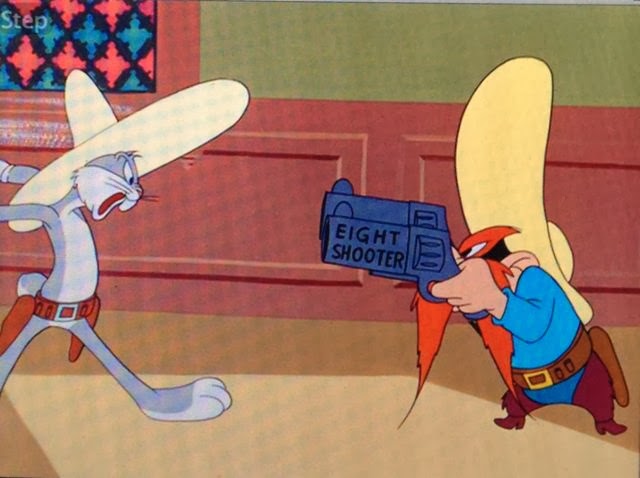
The big showdown between Bugs and Sam (six-shooter, seven-shooter, eight-shooter, nine-shooter, ten-shooter, pea-shooter) contained a surprise and a puzzle when viewed frame-by-frame: the animation of the quick draw action for Sam was mostly on two's; for Bugs, it was mostly on one's.

If you are not familiar with this terminology, here is a little explanation: it was generally held even at Disney that most action could be presented smoothly enough on two's--that is, two frames of film exposed for each drawing in film that ran at a projection speed of 24 frames per second.  So, for one second of action, you might need only 12 drawings instead of 24.

However, for very fast action, and especially where drawings exposed on two's would not overlap at all  (and overlap helps to smooth out the flow of animation), it was regarded as necessary to have a drawing for every frame of that very fast action.

Thus, an animated sequence could be expected to have sections where the slow bits were on twos and the very fast bits were on one's.

(Another circumstance where it is considered necessary to animate on one's is during a camera pan movement, because since the background is moving on one's, the character has to be doing the same.)

In the showdown between Sam and Bugs, they face each other and draw their two guns alternately.  Here is where I observed a difference in their animation.  It became obvious because this sequence escalates.  Sam has six-shooters; Bugs draws seven-shooters; Sam draws eight-shooters, and so on until Sam draws ten-shooters and Bugs draws a pea shooter.  And the same timing shows up in each instance  (and, yes, the animation is different each time; the studios at this point in animation history seldom engaged in reuse of animation.)

Below are the key frames from just one part of this action, where Sam draws eight-shooters (on two's) and then Bugs draws nine-shooters (on one's).  Let's look at them now, and then I will say more about them.

Start of the action.
Sam drawing one: 1 frame.
Sam drawing two: 1 frame.
Sam drawing three: 1 frame.
Sam drawing four: 1 frame.
Sam drawing five: 2 frames.  Here I skip 2 drawings of 2 frames each which are the anticipation as he grips his holstered guns.

Sam drawing eight: 2 frames.
Sam drawing nine: 2 frames.
Sam drawing ten: 2 frames.
Now it is Bugs' turn to draw.
Bugs drawing one: 1 frame.
Bugs drawing two: 1 frame.  Again, I skip a few frames as Bugs says something, then gets ready to draw his pistols.
Bugs drawing nine: 1 frame.
Bugs drawing ten: 1 frame.
Bugs drawing eleven: 1 frame.
Bugs drawing twelve: 1 frame.
Bugs drawing thirteen: 1 frame.
And they hold on the final drawing.
Studying this frame by frame, I wondered why it was that Bugs' draws were on ones (or 1's; to me it doesn't matter how you write it) and Sam's were on twos.  I even wondered momentarily if a separate animator had drawn each character.

Playing it with sound, everything became clear to me.  The timing is driven by the dialog.  Each character says something like, "Oh, no it don't!", and draws his guns on the last word.  Sam, as voiced by Mel Blanc, draws his words out a bit longer than Bugs, also voiced by Mel Blanc.  The animator was simply hitting accents, and with Bugs he needed fewer frames to get to the accent.

But what an interesting look at the use of 1's and 2's this is.  The actions are quite similar, the difference between use of 1's and use of 2's is, in this case, just about undetectable.  And they both work.  All the usual techniques are here: stretched shapes, dry-brushed speed and motion lines or tracks, and even a one-frame smear when Bugs brings out his pea-shooter (not shown.)

I invite you to look at some animation this way.  Many console  DVD players offer this step forward feature, and the DVD player of my Macbook Pro also works well for this, except that it will not step backwards.

Note: All images in this post are copyright of Warner Brothers Entertainment, Inc., and are used with their imagined indulgence.

Sunday, November 17, 2013

No. 50, Jim on a Limb: One (Part 6)

Animating the scene shown and described in No. 49 was a matter of trial and error.  For the most part, the poses worked and it was just a matter of working out the timing.  For example, the two changes of expression (from despair to determination, then to cunning) were at first almost identical in their timing.  I realized then that coming one right after the other, they needed to be different from each other.
Despair to determination is now shorter in frames, and the hold at the end is also shorter, than both those things in the second transition, from determination to cunning.  The latter thus gets more stress, and fittingly becomes the more important.

Three expressions: despair, determination, cunning.


To view the difference in timing, go here.

One pose that had to be re-done was this one showing her slumped down in despair.  For this character I wanted to use that limp-wristed attitude that at one time was so common among women when their hands were idle, but my first try had produced a pose that did not quite express the despairing mood. 


Also, when I saw the test in animation, I didn't like the movement, which showed the forearms and hands pulling back up too far after dropping down. It did not express the intended attitude of resignation and despair.

I replaced that pose with the one shown below, and I damped the movement until it seemed just right.


But one thing did go as I had hoped, and I got it right first time out.  This is the final movement where she settles into her attitude of supplication; she is saying, "Give me a break!  What did I ever do to you?"  Her arms come up and she knocks her fists together three times, hunching up her shoulders.


When something like this does go right, it makes all the other struggles worthwhile.


Next: Jim on a Limb: One (Part 7)  Doing What Is Necessary

Sunday, November 10, 2013

No. 49, Jim on a Limb: One (Part 5)

Note: I have now numbered all my posts chronologically, in addition to having series and subject headings.  I think this will make it a little easier for me to refer back to previous posts, and for you to locate them, especially as the parts of  series are are not always consecutive.


The Pencil Test


Here is the pencil test of Victoria as promised in my last post.  Remember that the fox has her firmly by the nose throughout this scene.  I have not included that layer of the fox only because using too many layers in a pencil test makes for a dark and murky image that you may have trouble viewiing.

[movie]

It works pretty well now, but as in most complex things that one tries to plan in advance, there were some changes along the way.


Changes to the Plan


First, two new extreme poses were added.  They fall between poses E and F as shown in Part 4.  Here are those poses again, with the new ones placed inbetween.

Pose E
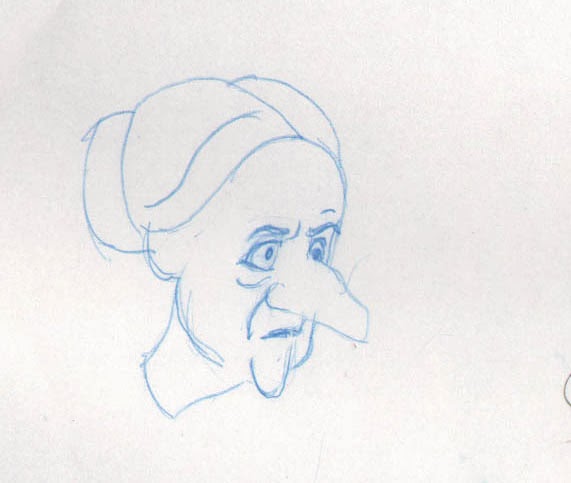
Pose E expresses her feeling of despair.


Pose E-1
The first new pose, call it E-1, shows her stubborn nature returning; she will not be defeated!


Pose E-2
The second new pose, E-2, is a cunning expression; she has an idea and she is calculating whether it will persuade the fox.


Now we go to pose F and then G, where she gathers herself and then adopts an attitude of pleading or supplication.


Pose F

Pose G

Thus we have her thinking her problem through in a way that the viewer can easily follow.  This is the sort of deep exposition that I am just now learning to do, and which I have often failed to understand in the past, largely because my experience in professional animation has been mostly confined to commercials of 30 seconds or less, with no time and frames to spare for looking into a character's motivations and thought process.


In Part 6, I'll talk about how the animation itself went on this little scene.

Next: What Came Easy, and What Was Hard


Friday, October 25, 2013

No. 48, Jim on a Limb: One (Part 4)

Six weeks since I have posted.  Partly it was this and that, an illustration job, a couple of commercial jobs, the re-designing of my website, a busy late summer.  But also it was the difficulty of the problem here--the one I last mentioned in post no. 45, Jim on a Limb: One (Part 3)--in which I laid down the key drawings I needed to animate.  If you want to follow the continuity of this demonstration, please go back now and look at that post.

How It Looks in Pencil Test


Here is the result:

Of course this test is focused on the man.  His name is Albert.  I also have animation of the woman  about ready (her name is Victoria), but because too many layers make the pencil test dark and difficult to follow, I have left off all layers here except for two: Albert, and Albert's Head.

This is about what I wanted it to be in so far as Albert is concerned.  I think you can see him thinking.  He gets serious and cautious at the beginning, he communicates his plan to Victoria, and when he gets bumped in the nose by the fox as he lowers him down, Albert doesn't let it bother him much.  One thing I will make more clear is Albert's expression, which will remain disapproving until, at the end, he relaxes his stern expression to gaze in perplexity at the fox, who is behaving so badly.

Next it is Victoria who will try to deal with the fox, first as if to make some argument, then feeling hopeless, and finally just appealing to his good nature.  And all without a word of dialog or narration.

I have begun by adding a few more key drawings to define Victoria's performance; the first ones would be sufficient for a storyboard, but the animator must go further and think of everything that will be in the character's performance.

Victoria regards the stubborn fox.
Pose A is the last pose of the pencil test above.

She resolves to try something to make the fox let go.


Pose B shows her determination to act.  It also is an anticipation to Pose C.

She moves as if to speak out loud to the fox...
Pose C.  She might be about to actually say, "Why won't you let me go?"

...but stops short, realizing the futility of this.
Pose D pulls back a little from Pose C.  She holds for 16 frames, blinks.

Victoria slumps, feeling the situation as hopeless.
Pose E  expresses her feeling of despair.

An anticipation to pose G.
In Pose F, Victoria gathers herself for one last attempt.

The last pose: with her eyes she pleads for the fox's mercy.
Pose G shows her final supplication as she bats her eyelids and beats her fists together.

This is a tough bit to do because it is designed so that the character can barely move her head; where the fox grips her by the nose is a pivot point and anchor for the whole character, and the animator must work only with her expression, with her arms and hands, and with some cautious movement of her shoulders and body.


Next: Victoria and the Fox: the Pencil Test