Pages

For People Crazy About 2D Animation!

Acme Punched! is for people crazy about 2D animation. It may be enjoyed by beginners and others, but it is aimed at animators who know already something about the process of animation and the basics of character animation. In large part, it will attempt to provide a deep look into the problem solving that goes on in my head as I work out a scene, often in step-by-step posts that I will sometimes enter in "real time", without knowing in advance what the outcome will be. Mistakes and false starts will not only be included but emphasized, so that the creative process of animation will be portrayed realistically. And, while my own bias is for 2D drawn animation, many of the effects and principles discussed here can apply to CGI 3D animation as well. I hope the blog will prove useful and instructive for all.

-Jim Bradrick
Showing posts with label Book Reviews. Show all posts

Thursday, February 4, 2016

No. 89, "Easy Way to Draw"

My first real interest in 2D cartoon animation was inspired by a 1950's TV show, Woody Woodpecker. Each half-hour show was comprised of four theatrical cartoon shorts produced by the Walter Lantz studio over the past two decades, plus a live-action segment in which studio head Walter Lantz would do a mini documentary about some aspect of animation production.

Here is a link to one such segment now showing on You Tube.  Seen today, the live action footage includes scenes that were clearly staged for the filming, such as story conferences and animator interactions. But at the time I felt I was being let in on animation production secrets. Indeed, there was little information available to the general public on this subject, so anything at all was better than nothing.

At the time I could not discriminate between Walter Lantz studio quality and that of the Walt Disney organization, nor between Lantz and Warners or MGM. But I did recognize the sophisticated animation in the Woody Woodpecker cartoons of the late 40's and very early 50's, and I didn't know then that they were more the work of directors Shamus Culhane and Dick Lundy and their animators than of Lantz himself. It was Walter Lantz who seemed to have reached out to me, and so I wrote him a letter.


When the personal answer arrived, I was thrilled to be treated with respect and to have been acknowledged by this important animation producer. The book he mentions is Walter Lantz "Easy Way to Draw".  I don't remember now if I got the book because he mentioned it, or if I had it already.  It was an attractive book published by Whitman Publishing, who published hundreds of titles for children including many, many coloring books. This book was more-or-less in the style of a coloring book, and the illustrations were quite appealing.


As promised, there were many pages of step-by-step illustrations of the drawing of the Walter Lantz characters, and I tried and tried to copy and then extrapolate from these examples.

The bogus "basic shapes" process of drawing that has been enshrined in
so many learn-to-draw books over the years.

The only problem was, though there may be an easy way to draw, there is no easy way to learn to draw.  Aside from the examples of a very few natural artists, the rest of us have to work very hard to draw well. The professional artists who illustrated these pages had worked for years to be able to do this kind of work.  And let's face it, no one draws like this. How-to-draw-it lessons like these are really deconstructed; the artist starts with a finished drawing and works backward to arrive at the basic shapes.  I know, because I did it myself one time in a book called You Can Draw Animals Right Down to the Skin.

My own lesson in how-to-draw--or how-NOT-to-draw!

I can think of a dozen examples illustrating this same bogus process, including a wonderful parody by Farside creator Gary Larson.

Nevertheless, I was inspired. I yearned to be able to draw like this, well enough to be paid to do it. I kept after that dream, and eventually I have, I believe, learned to do it pretty well. But don't let anyone tell you that there is an easy way to draw, or an easy way to play classical piano, or an easy way to do just about anything worthwhile. There are only hard ways to learn an art, after which you may say you have "a way to make drawing look easy."

More exciting to me than the book itself was this picture on the back cover, my first glimpse of a real
animator's workspace: the desk, the shelving, the coiled pencil holder and the metal drawing disc with
Acme pegs. (actually, these pegs look like they might be Oxberry, a slight variation on Acme that was
common at one time in east coast studios.)
Next:
A Woody Woodpecker walk cycle I did at 12 years old.  Plus, proof that I could do 3D if I wanted to!


Wednesday, November 18, 2015

No. 81, Book Review: The Nine Old Men, by Andreas Deja.


By the beginning of Franklin Roosevelt's second term as President in 1937, he had begun to call the U.S. Supreme Court justices of the time "the nine old men" for their obstructive attitude toward his social policies and programs.  It became his aim to try to replace six of their number in order to get a court more friendly and supportive of his attempts to bolster the economy.

Roosevelt failed in that, but the phrase Nine Old Men was picked up by Walt Disney and applied to his crew of senior animators, who just happened to be nine in number. Who were these men? Among other things, they were all animators who had stayed on Walt's side during the studio's labor troubles of the early 1940s. All nine were born between 1907 and 1914, and all but one started at the Disney studio in the early to mid thirties when intensive hiring and training were ramping up for the move into feature animation. (The exception was Les Clark, who began in 1927 at the age of 20, which made him the only one to arrive before both sound and color came to the movies). None of these young men except Clark had animation experience, and Clark had to retrain himself now to keep up with the sophisticated design and animation that was in development; the old rubber hose limbs and often crude drawing of the silent days were obsolete.

Les Clark learned to animate very well indeed.  From Symphony Hour, 1942.


In the new book by Andreas Deja, The Nine Old Men (392 pages, CRC Press, 2015), these animators are spotlighted and compared with one another in their strengths and styles from the personal viewpoint of the author, a brilliant animator in his own right who knew many of them and who actually trained under Eric Larson, best known for his animation of the sultry dog Peg in Lady and the Tramp.

Larson didn't do only animals.  Here, from Peter Pan, Wendy fails at her first attempt to leap into flight. Now she crouches for a second attempt.


As in John Canemaker's 2001 book of a similar title, Deja's book is divided into nine sections, each devoted to one animator. But the new book, subtitled Lessons, Techniques and Inspiration from Disney's Great Animators, is all about the drawing and the animation, with shorter illustrated biographies that detail each man's development at the studio from novice to mature artist. The latter part of each chapter is comprised of sequences of key animation drawings from important work along the career arc of the artist.

If you want to get as close as you can to the work of a master animator, there is nothing short of being inside the man's head that is better than to look at his pencil animation. I have always treasured reproductions of animation pencil drawings, and there have been some good collections.  Examples in the past include the oversized Treasures of Disney Animation Art (Abbeville Press, 1982) and The Walt Disney Studios Archive Series volume on Animation (Disney Editions, 2009). Both of these are made up of color reproductions (even of mostly black and white drawings!) that have been printed the actual size of the originals. Wonderful to look at, but limited in the amount of material that can be covered in a single volume.  And the otherwise terrific Illusion of Life, written by Frank Thomas and Ollie Johnston (Abbeville Press, 1981), though considered an essential bible by most of us who love drawn animation, contains numerous animation sequences that are disappointing on the page, each image in a stark black and white that illustrates the action without displaying the subtleties of the artist's drawing.

Frank Thomas, a Nine Old Man and co-author of Disney Animation: The Illusion of Life, does Merryweather the fairy, from Sleeping Beauty, 1959.


Andreas Deja and his publishers have found a happy medium,  reproducing in color all the pencil lines, because those lines were not only black or grey; a single drawing might also include pencil lines in blue or red--sometimes even green and ochre! The multiple colors were used for roughing in or for indicating match lines or other cues for those who would ink the drawings onto cels. As a bonus, almost all the drawings in the sequence sections include the original drawing numbers written on the sheets by the animators.  The serious student of animation can deduce much about the timing of the scenes from these notations.  Seldom included here, alas, are spacing guides, which can be even more revealing.

A Woolie Reitherman drawing from the El Gaucho Goofy segment of Saludos Amigos, 1943. Note the use of multiple colors of pencil.  Note also this amazing action drawing by Woolie!


Though not the only good animators at the studio, the Nine were all excellent, they had the all-important support and respect of Walt Disney, himself, and they got the cream of the important scenes to animate.  Eventually they mostly became supervising animators, mentoring younger animators such as Andreas Deja, Glen Keane, and many others who were to succeed them when they retired.

Two frames of Smee from Peter Pan, by Ollie Johnston, who was known for his light touch, sensitive emotional interpretations, and speed.  Johnston is the other co-author of Illusion of Life.


Deja has the advantage over other Disney historians in that he lived the life, producing in his own right numerous memorable animated performances such as villains Gaston, Scar and Jafar, and the comic hero Hercules. His insights about these men and their work are keen, and his own unflagging enthusiasm for his subject shines through.

Somewhat amazing is the wide variety of personalities and temperaments among these men who, nevertheless, were all able to sit and perform these feats of acting and creation at their drawing desks. Several, despite their differences, had the discipline and versatility to follow each other's lead in design and animation on a character, so that they could provide sequences of their own that integrated seamlessly with the other man's work.

John Lounsbery could even capture the style of Milt Kahl, and he could define his own characters, too.  Here, John's character Ali Gator, from the Dance of the Hours sequence of Fantasia, 1941.

Ward Kimball managed to get through his Disney career without once having to animate a realistic character like a prince or princess.  He liked it that way, but he was amazingly innovative both as a designer and in staging his scenes.  Here are some wonderful Kimball roughs from the Peter and the Wolf segment of Make Mine Music, 1946. 

Milt Kahl, because of his wonderful draftsmanship, did more princes  than anyone, but he enjoyed the cartoony stuff as well.  Here is the eponymous star of Pinocchio, 1940, as he finds himself turning into a donkey on Pleasure Island.


Marc Davis, creator of Flower the skunk in Bambi, 1942, and two immortal female villains, Maleficent in Sleeping Beauty, 1959, and, shown here, Cruella DeVil from 101 Dalmations, 1961. Davis then became a principal designer for attractions at the Disney theme parks.

Any student or practitioner of 2D animation should certainly have this book for both inspiration and study, and 3D animators and designers could also learn from it.  These are the very men who discovered and perfected what are now known as the 12 Principles of Animation.  The Nine Old Men are all gone now, but they have much yet to teach us.

All images copyright Disney.
Thursday, September 11, 2014

No. 74, Rare Animation Books: The Animated Film

The Animated Film, by Roger Manvell, pub. 1954 by Sylvan Press. 63 pages.


This book, subtitled "with pictures from the film 'Animal Farm' by Halas and Barchelor", was remarkable in its day for not being about the Walt Disney studio.  Indeed, it was about a British studio and their production of the first British feature-length animated film.  Across the pond at Disney, work was going forth on Lady and the Tramp, another sentimental adventure with songs that had become a Disney mainstay.  Animal Farm was nothing of the sort.

The film was based on a popular book of the same name by George Orwell, who was a journalist and, later on, author of the  more famous dystopian novel 1984. The book was a satire of the communist form of government and, more specifically, of the Soviet version of communism, which in its heavy handed way had become in many ways indistinguishable from fascism.  It told the story of farm animals who rise up and overthrow their human master and then attempt to govern themselves, with the more cunning and ruthless among them eventually rising to the top.  "All animals are equal," goes the famous quote, "but some are more equal than others."

Expressive animation of the pig who decided he was "more equal than others."


Two still frames in black and white from the color film Animal Farm.


Today it is known that the CIA, interested in any kind of anti-Soviet propaganda, obtained the film rights to Animal Farm, and that under the direction of Howard Hunt (of Watergate infamy) the producer Louis De Rochement was chosen as front man.  De Rochemont then selected the Halas and Batchelor studio to create the film. It is not generally believed that the studio had knowledge of the source of their funding at the time.

The Halas and Batchelor workflow chart of animation production.


The film was remarkable for being of adult interest rather than that of children.  John Halas, a Hungarian immigrant to England, and his wife and partner, Joy Batchelor, expanded their studio to a staff of 70 for the production. Three years, from 1951 to 1954, were spent in the making of the film. The technique and style chosen were not unlike the Disney model, with drawn animation traced and painted onto cels, and with care taken to achieve a certain amount of realism in the movement and design, again in the mode of Disney.  It was, after all, intended to be released as a commercial product, so it needed to be able to compete.

A page showing development of the design for one of the human characters in the film.

Model sheets of some of the animal characters.


The book includes expressive model sheets of the characters, sections of storyboard, layouts and animation drawings.

A detail of the Tension Chart.


An interesting insert is a foldout "Tension Chart" showing the flow of tension or excitement from beginning to end, including notes on mood, music and color.

Background layouts.


But although the film was in color, the books illustrations are all in black and white.  Altogether it is a fascinating look through a parallax lens of feature animation production in a country other than the US.

Views of production work around the Halas and Batchelor studios.


Roger Manvell, the author, was a writer who had worked for years with Halas and Batchelor "as a researcher, author and screenwriter", according to the 2006 book Halas and Batchelor Cartoons, An Animated History, by Vivien Halas and others.  In addition to The Animated Film, he also wrote in association with John Halas three other books on animation.

The Animated Film is out of print and likely to be very difficult to obtain.

Wednesday, September 3, 2014

No. 73, Rare Animation Books: The Art of Animation

The Art of Animation, by Bob Thomas, 187 pages. Pub. 1958 by Simon and Schuster.

 This colorful book was conceived around the Disney studio's production of Sleeping Beauty (1959) and showcases its art in particular. And unlike the Robert D. Feild Art of Walt Disney, published in 1940 and reviewed in my post no. 72, it gives due credit to the names and personalities of the many great Disney artists throughout the history of the studio. Surprisingly, there is even a Compilation of Animation Credits section at the end. On the other hand,  it is also like the previous book in that it has the taint of a corporate production, a Disney promotion that makes no mention of any other studio or of anything negative such as the labor union battles of the 1940s or the diminished interest of Walt Disney himself in his animated productions.

A double-page spread using a still from the film of Sleeping Beauty.


The Disney story was presented in an entertaining and beautifully laid out book.  There was plenty of production art to look at, though it was often juxtaposed with non-production art that had the look of Little Golden Books art--flattened, not quite on model.  Even as a boy I recognized and resented this insertion by an art director of what I considered second generation interpretations of the real thing.

Another spread showing stills from three cartoons, two illustrations featuring production art, and at lower right a Golden Books-style illustration.


Nevertheless, there was information here that had never before reached such a wide audience, much of it in archival photographs and their captions.

Shot of a story conference in the old Hyperion studio, mid 1930's.  That's inspiration artist Albert Hurter at extreme right.

First photo and first mention of which I am aware of Disney's Nine Old Men of animation. The term was not used by Walt endearingly.


Pictures of the animators at work intrigued me particularly, as they showed the artists with pencils actually in hand, actualy animating, the stacks of drawings and pinned-up model sheets all around them. To me, already in love with the idea of animating as a career, it was thrilling.

Animator Ollie Johnston at his board, mugging into his mirror while animating a fairy.


Looking back from 2014, with all the wealth of critical writing about Walt that we now have, with all the interviews and research accomplished by animation historians like Jim Korkis and Mike Barrier, the Bob Thomas book seems without depth, but it marked the beginning of a time of greater interest in the people of animation who made Walt Disney look good and in the art of animation itself.

A spread showing the work of background stylist Eyvind Earle, whose angular and geometric designs influenced even the character design in Sleeping Beauty.


My copy is a first edition that I have owned for more than fifty years, as evidenced by its worn appearance.  An internet search through rare booksellers or ebay might turn up a copy for you.

Tuesday, August 26, 2014

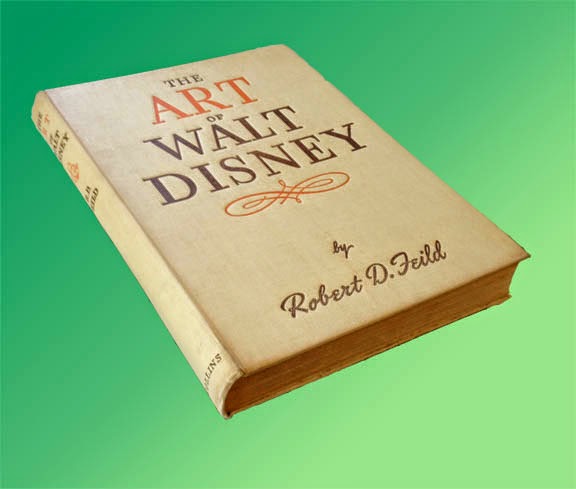
No. 72, Rare Animation Books: The Art of Walt Disney, by Feild

The Art of Walt Disney, by Robert D. Feild, 290 pages, pub. 1942 by Macmillan and Co.


First, you should understand that there are  two completely different books called The Art of Walt Disney. The better known of these is the most recent, a massive coffee table book by Christopher Finch first published in 1974.  In fact, when I went to Amazon just now to look at reviews of the earlier Art of Walt Disney, I found that all the reviews seemed to be of the 1974 book; all these people had no knowledge of the one published in the 1940s.  But the Finch version, rich in color artwork but short on real information about the animation studio, was for me a vast disappointment.

The other book known as The Art of Walt Disney was published in 1942 and written by a professor of art who was given a year of access to the Disney studio in Burbank between 1939 and 1940.  An interesting year it was, too, for Snow White and the Seven Dwarfs had premiered successfully in 1937, proving the viability of feature-length animation and spurring the studio to initiate production on not one but several new features.  The book therefore contains details on the production of Pinocchio, Fantasia, Bambi and Dumbo, all of which were in various stages of development, as well as many animated short subjects which were still a major division of production at Disney.

Early concepts of the 7 dwarfs. Some of these are by Albert Hurter.


As an art historian Feild admitted to a quandary about what the animated productions of the Disney studio actually meant as art, but he knew he was onto something big and exciting.  Disney the producer had thrown far more money back into raising the standards of animation than he had kept for himself, and the result was a clear lead in production quality and standards over every other Hollywood studio.  Efforts by other countries, from the Disney point of view, did not even exist.

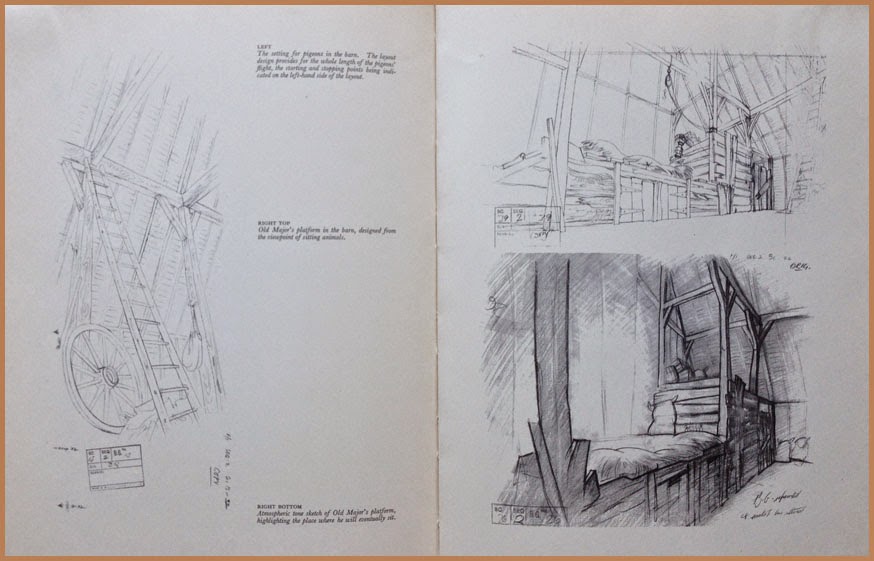
Layout sketches, possibly by Tyrus Wong.


The book itself was the first serious literary survey of Disney or of any animation, and its publication was a tribute to the new recognition and respect accorded to Walt Disney after his sensational breakout from shorts starring Mickey Mouse, Donald Duck and Goofy into the world of feature films.  For an exhilerating two years or so after the release of Snow White, anything seemed possible and the continued success of the studio seemed assured.

World war beginning in  1939 with Hitler's invasion of Poland ended all that, closing lucrative distribution markets in Europe and, after 1941, diverting much of the studio's energy into jingoist war propaganda.  According to a 1942 review in Saturday Review, however, the book went to press before the December, 1941, bombing of Pearl Harbor, and so Feild's writing was not influenced by the direct involvement of America--and Hollywood--in World War II.

These may be examples of Shamus Culhane's "fast animation" technique.


There is an oft-told story of Walt Disney confronting one of his ambitious young artists back in the '30's, telling him not to get any ideas about making a name for himself at the studio; the only name the public was to see was that of Walt Disney. The story is true, though of course the features from Snow White on had artist credits just like any other feature films.  But Feild in his book maintained Disney's attitude about keeping the artists anonymous, and so there is not a single animator or designer mentioned by name in the entire book. From the point of view of historical interest, this is an unfortunate omission, although subsequent writing over the ensuing decades has illuminated some of this darkness. One can easily recognize the work of Marc Davis, of Milt Kahl, of Rico LeBrun and others.

Some of Preston Blair's dancing hippo drawings, made famous in his animation book.


The text  is written in a somewhat verbose style typical of the day, but the book does a good job of detailing the Disney production process and even makes an attempt to describe the intricacies of animating. Much is made of the expansive new Burbank production plant. Yet the refusal to name names continues to be an irritant throughout.  Besides Walt, only Roy Disney is mentioned by name.  How can you tell the story of Walt Disney without mention of Ub Iwerks?  Of Ham Luske and Norm Ferguson and Bill Tytla and Freddie Moore?  Yet Feild manages to keep them all behind the curtain, to the point that I suspect this anonymity was a precondition imposed on him by Walt.

Uncredited like all the others, here are some structural guides for deer animation by Rico LeBrun.


Nevertheless there are many full-page plates or illustrations, some in color, that make the book a worthwhile document of the Disney studio in the early 1940s.

Animation drawings of Ali the alligator, very possibly by John Lounsberry.


Feild's The Art of Walt Disney is considered a collector's item.  My copy is a British reprint (1944) published in London by Collins.  Copies available on the internet are few and  not inexpensive, but it is still possible to get one if you want it badly enough.


Wednesday, June 11, 2014

No. 67, More About Animating 4-legged Animals


Four-footed Movement


It is worth pausing here to talk a little about animating animal legs.  You might suppose that if you've seen one four-legged critter moving, you've seen them all, but this is far from true. Once I assigned the animation of a little cartoon goat to one of my animators on a children's game.  She did a perfectly acceptable job on it and I approved it, but a week later I happened to see a goat walking and was struck by how the goat appeared to be walking tip-toe, like a woman wearing 5-inch heels and having to bend her knees slightly.  That's how they walk! It would have been a charming touch to have included in the scene.

In my last post I mentioned a book, Dog Lomotion and Gait Analysis, by Curtis Brown (Hoflin Publishing) that is a favorite reference for this kind of thing.

Dog Locomtion and Gait Analysis, by Curtis Brown

If you are interested, I find that this book is still available.  I also see that there are now some others on the same subject, but I cannot speak about them.

Even within a single species, not all animals move alike.  That is especially true of dogs, which have been bred to take so many different forms and proportions. Tall dogs, for example, tend to use the pace (moving both right legs forward together, then both left legs) instead of the trot (a front leg moves forward with the opposite rear leg).  Terriers will never move like greyhounds, even walking and standing.  The book goes into all this and more in great detail--in fact, probably in more detail than one would ever need.  But if I were animating a Lady and the Tramp or a 101 Dalmations today, I would certainly want this book at my desk.

A typical double-page spread from the book.
 I discovered Dog Lomotion by chance, and I have had my copy for many years.  In fact I wrote a review of it for Animation World Network back in 2000. Here is the link if you would like to read that review.

Of course now there is a wealth of movement reference of animals on the internet, most of it free as in YouTube, and I recommend that you take advantage of it whenever your assignments call for some realism in animal movement.

Elegant Anatomy


Let me draw your attention to one particular detail of four-legged anatomy that I think is common to all digitigrade mammals: the pastern.  Digitigrade means walking on the toes, as distinct from plantigrade, which means walking on the flat of the foot. (Bears and humans are plantigrade animals.) Most notably,  horses and dogs and cats have the pastern, as do all their close relatives.  It is a flexible joint in both front and rear feet that allows great energy to be suddenly released in running, and visually it is an animator's delight.


In the drawing above, from left to right, you can see the changes in the pastern joint of the front leg of a dog.  First it is compressed as it bears the full weight of the animal and propels him forward; when it is released and carried ahead it makes a sudden and beautiful flip, dragging the foot behind it; then as the whole leg is brought forward the foot drops down from the pastern, ready to make contact with the ground; and finally, pressure on the foot reverses the angle of the pastern once again.

Of course this all happens very quickly as the animal moves, but to include this action in the animation of dogs or other animals always adds a snappy elegance to their movement, and it is a prime example in nature of what the great animator Art Babbitt called "successive breaking of joints." You can exaggerate it; you can have fun with it; but you should never leave it out.

Here are 4 consecutive drawings from my fox's trot that show the pastern working.


Next:  Thought Process and the Animator


Monday, March 17, 2014

No. 57, Rare Animation Books: The Oldest Animation Book

 The oldest film animation book that I know of is so old, Walt Disney and Friz Freleng learned their craft from it.  It is so old, it predates not only color movies but sound movies.  It is ninety-four years old.


Published in 1920 by Scribners, the book is called simply Animated Cartoons, How They Are Made, Their Origin and Development, by E.G. Lutz.  Let's consider the state of the art in 1920.

In the United States the industry was dominated by such studios as Hearst, J.R. Bray and Paul Terry.  Many of the series being produced then were animated versions of popular newspaper comic strips, and were looked upon by the syndicates as additional promotion for their newspaper features.

The technology of motion picture film, cameras and projectors was just twenty-five years old.  Winsor McCay had produced Gertie the Dinosaur in 1914, just six years earlier.  Disney was still a very young man in Kansas City; he hadn't even begun his work for Kansas City Film Ad and Newman's Laugh-o-Grams, much less his Alice in Cartoonland series.  And Mickey Mouse?  The Mouse was still seven years in the future.  Even Felix the Cat, the  first-ever character and marketing sensation in animation, had just been established that year.

A Farmer Alfalfa of 1916, produced by Paul Terry at the old Barré studio.


A pre-1920 Mutt and Jeff, after the comic strip by Bud Fisher and produced by Charles Bowers at the old BarrĂ© studio. Note the sophisticated drawing in this one.
The book is actually a workable text for someone wanting to learn the trade at the time.  Beginning with an explanation of the principle of persistence of vision and a description with illustrations of a film shutter and projector, the book goes on to give a history of animation novelties like the thaumatrope and zoetrope that preceded film technology.  Then begins the how-to section, which takes up the greater portion of the book.

But for the registration system, this same design could be used today in the making of 2D animation.
The basic idea of the animation drawing desk--a glass or plastic panel, a backlight to enable you to see through several drawings, a way to register your drawings with one another--is unchanged to this day.

Timing back then, however, was quite a bit different, since the standard film speed before sound production was just 16 frames per second.  At that speed, the animator did not have to make so many drawings per second, but of course nothing was as smooth, either.

The registration system of the day, years before Acme or any system with oblong pegs and holes.
How cels were used in the beginning.
Transparent cels of nitrate celluloid were already in use by 1920, but production standards were poor and so they were often of variable thickness.  Also they were expensive, so their use was limited to hold cels for character parts that were not moving.  The illustration above shows that the moving arms and mouths were still to be inked onto paper, while the parts that were on hold were on cels registered on top of the paper.

How to design a walk cycle in 1920.
Movement cycles were in common use when Lutz wrote his book, but an animator's  understanding of how to convincingly convey weight and the plasticity of form were still a generation into the future.

Special effects, 1920-style!
Animated cartoons were then full of effects like these "sparks", as Disney called them, which were lifted straight from the panels of the newspaper comic strips out of which the medium was spawned.  At least the viewers were familiar with the symbolism.

The book's title page.
In my case I was lucky to find a first edition of this old book some years ago at Powell's Books in Portland, Oregon.  Since then, however, a facsimile edition has been published by Drawingbooks.org, so you can get your own in hardbound or paperback.  There is even a Kindle edition available for a very small charge!