Pages

For People Crazy About 2D Animation!

Acme Punched! is for people crazy about 2D animation. It may be enjoyed by beginners and others, but it is aimed at animators who know already something about the process of animation and the basics of character animation. In large part, it will attempt to provide a deep look into the problem solving that goes on in my head as I work out a scene, often in step-by-step posts that I will sometimes enter in "real time", without knowing in advance what the outcome will be. Mistakes and false starts will not only be included but emphasized, so that the creative process of animation will be portrayed realistically. And, while my own bias is for 2D drawn animation, many of the effects and principles discussed here can apply to CGI 3D animation as well. I hope the blog will prove useful and instructive for all.

-Jim Bradrick
Showing posts with label Commentary. Show all posts

Thursday, February 4, 2016

No. 89, "Easy Way to Draw"

My first real interest in 2D cartoon animation was inspired by a 1950's TV show, Woody Woodpecker. Each half-hour show was comprised of four theatrical cartoon shorts produced by the Walter Lantz studio over the past two decades, plus a live-action segment in which studio head Walter Lantz would do a mini documentary about some aspect of animation production.

Here is a link to one such segment now showing on You Tube.  Seen today, the live action footage includes scenes that were clearly staged for the filming, such as story conferences and animator interactions. But at the time I felt I was being let in on animation production secrets. Indeed, there was little information available to the general public on this subject, so anything at all was better than nothing.

At the time I could not discriminate between Walter Lantz studio quality and that of the Walt Disney organization, nor between Lantz and Warners or MGM. But I did recognize the sophisticated animation in the Woody Woodpecker cartoons of the late 40's and very early 50's, and I didn't know then that they were more the work of directors Shamus Culhane and Dick Lundy and their animators than of Lantz himself. It was Walter Lantz who seemed to have reached out to me, and so I wrote him a letter.


When the personal answer arrived, I was thrilled to be treated with respect and to have been acknowledged by this important animation producer. The book he mentions is Walter Lantz "Easy Way to Draw".  I don't remember now if I got the book because he mentioned it, or if I had it already.  It was an attractive book published by Whitman Publishing, who published hundreds of titles for children including many, many coloring books. This book was more-or-less in the style of a coloring book, and the illustrations were quite appealing.


As promised, there were many pages of step-by-step illustrations of the drawing of the Walter Lantz characters, and I tried and tried to copy and then extrapolate from these examples.

The bogus "basic shapes" process of drawing that has been enshrined in
so many learn-to-draw books over the years.

The only problem was, though there may be an easy way to draw, there is no easy way to learn to draw.  Aside from the examples of a very few natural artists, the rest of us have to work very hard to draw well. The professional artists who illustrated these pages had worked for years to be able to do this kind of work.  And let's face it, no one draws like this. How-to-draw-it lessons like these are really deconstructed; the artist starts with a finished drawing and works backward to arrive at the basic shapes.  I know, because I did it myself one time in a book called You Can Draw Animals Right Down to the Skin.

My own lesson in how-to-draw--or how-NOT-to-draw!

I can think of a dozen examples illustrating this same bogus process, including a wonderful parody by Farside creator Gary Larson.

Nevertheless, I was inspired. I yearned to be able to draw like this, well enough to be paid to do it. I kept after that dream, and eventually I have, I believe, learned to do it pretty well. But don't let anyone tell you that there is an easy way to draw, or an easy way to play classical piano, or an easy way to do just about anything worthwhile. There are only hard ways to learn an art, after which you may say you have "a way to make drawing look easy."

More exciting to me than the book itself was this picture on the back cover, my first glimpse of a real
animator's workspace: the desk, the shelving, the coiled pencil holder and the metal drawing disc with
Acme pegs. (actually, these pegs look like they might be Oxberry, a slight variation on Acme that was
common at one time in east coast studios.)
Next:
A Woody Woodpecker walk cycle I did at 12 years old.  Plus, proof that I could do 3D if I wanted to!


Thursday, January 7, 2016

No. 86, The Value of the Second Draft

There was a time when I was writing novels instead of working at animation.  In that time I was seldom ever 'blocked' in the sense of being unable to move forward.  Early on, I perceived that in the first draft, the point is to get the basic idea down on paper.  Writers who waited until it came out right the first time were the ones that got blocked.

Once you have it down on paper, you no longer have to worry about the empty paper; you can concentrate on fixing what is there.  And almost always, it got better in the second draft.  If it went to a third draft, so much the better.

As a film maker, I feel it is much the same process.  As a character designer too.  As an animator, however, I admit I want to get it right the first time, because of the labor. But in a way, if you plan it right, if you do your thumbnails, if you think it through down to the last blink and breath drawn, then you really have done one draft at least by the time you sit down to really animate.

Here is an example that happened just today. It involves both storyboarding and character development.


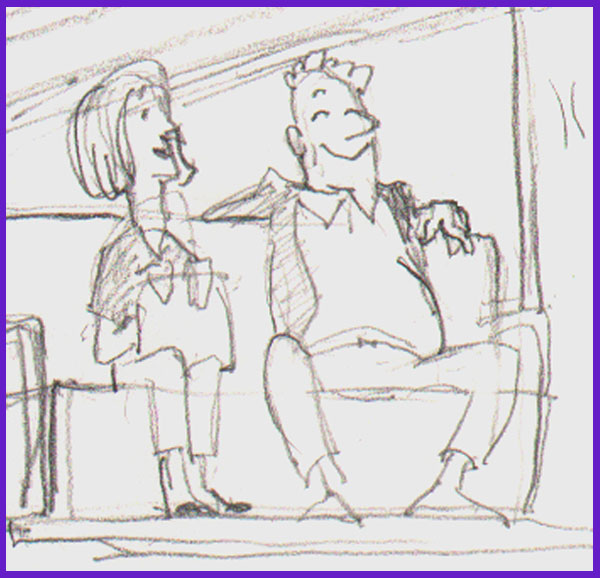
I had made this drawing of an electric airport cart from the rear, showing two passengers riding backward and looking happy about it.  Working on my storyboard today, I redrew the cart to fit my scene; the cart had to be facing left instead of right. Instead of tracing it and flipping the image, which might have been easier in some way, I just redrew it.


As I drew, I thought about the couple riding on the cart, and although they are minor characters, I decided it would be effective to add some contrast and interest by making the woman neat and prim and the man a sort of slob. They are still having a good time together, but now they are not alike.


The man is guilty of what we are calling in America the "subway sprawl", where his legs are spread wide apart in a comfortable but sometimes intimidating way.

The original sketch would have served well enough, but the second one is funnier and shows more character in a single pose, all because, instead of just copying the original, I gave it a second draft.

Next: More about storyboards, including my own Breakthrough!


Saturday, December 5, 2015

No. 83, Locked Out of Linked In Groups

LINKED OUT


Update: as of the new year, 2016, this issue has been resolved (or my period of exile ran out) and I am now able to post to my groups once again.

When you run a blog like this one, you want as many people to see it as possible.  And you don't want just anyone to see it; you want everyone with an interest in the subject matter to see it. Naturally, the greater readership you have, the more responsibility you feel to do a good job, and also the more satisfaction there is in blogging. So, you look for the best ways to get people (in my case, mostly animators) to notice it and take a look and, it is hoped, become a Follower.  Up until now, my best path for that has been the various Linked In groups for which animation is the focus.

Each time I posted to my blog, I would run a notice about it on relevant group sites, and typically I would get a surge in page views.  In this way, I have been gradually building up my readership.

Suddenly, however, I find that I am blocked from free access to those groups.

With a little checking, I found that just one complaint of impropriety, spamming or self-promotion, whether or not it was justified, was enough to get you blocked from a group. But in Linked In, this now pulls a trigger that blocks you from all your groups for an unknown amount of time.  This has now happened to me.  In some cases, my postings to the groups do show up on the group web page, but not in the periodic emails promoting activity in the group. On the internet, discussions of this problem by others who have felt unfairly blocked have revealed no good solutions or effective avenues of appeal.  One person suggested appealing to the group moderators, but many groups now do not list their moderators and their contact information, and anyway this would not clear the other blockages that have been automatically triggered. And Linked In has no editors or supervisors to whom to appeal for a review of one's situation.

As to the nature of my postings, are they inappropriate? Certainly not; they are targeted to the very narrow-interest groups most likely to want to see them, and their content is as free of socially questionable material as I can make them.  And also they are most definitely not spam, unlike the recruiting and job help postings that have been clogging group emails since I began my blog.

And what about self-promotion? Well, of course it is self-promotion, but no more so than a post by a young animator who wants people to look at his or her demo reel or animated sequence.  In fact it is less so, because my blog is informational and instructional; it is possible sometimes to learn something from it that may help a less experienced animator to improve his skills or to avoid some mistake in approach or execution.

 There may be another avenue open, such as Google Communities, or perhaps I will get reinstated sometime. For now, I am flummoxed.


Tuesday, December 1, 2015

No. 82, Adventures in Character Design, Part 1: Looking for My Character

What to Do when an Idea Isn't Working

Recently I came to a place in the planning of my new personal film where I felt blocked.  The concept was of two characters having a confrontation in an airport, and as I tried to commit the whole thing to storyboard, my progress and enthusiasm ground to a halt.

The original main characters.

I expressed this to a close friend who is also an animator, and he just shrugged and said, "Well, maybe there is something wrong with the whole idea. Rethink it."

Immediately I felt re-energized. And I also felt relief, because I was keeping with my new resolve not to animate anything without first storyboarding to the end. So I had not wasted a lot of work.

I began sorting through the ruins of my concept like a man standing amid the tornado-riven rubble of his home, looking for what might be salvaged.  There were some good character designs, and there was the airport location. There was a gag about an oversized suitcase that couldn't possibly make it past airport security and size regulations as a carry-on.

Part of the ruin was what had been my main character, a goofy guy who was funny-looking but hard to understand or empathize with, even for me. He was the one with the suitcase, and now I saw that he had to go, and he had to leave the suitcase behind.

Keep the suitcase, lose the guy. These are my first sketches of the character, from a traveling notebook.
 But what could I replace him with?  Was it necessary to start over with that, too?  Or was there possibly something already there?

Next: A New Start

Wednesday, November 18, 2015

No. 81, Book Review: The Nine Old Men, by Andreas Deja.


By the beginning of Franklin Roosevelt's second term as President in 1937, he had begun to call the U.S. Supreme Court justices of the time "the nine old men" for their obstructive attitude toward his social policies and programs.  It became his aim to try to replace six of their number in order to get a court more friendly and supportive of his attempts to bolster the economy.

Roosevelt failed in that, but the phrase Nine Old Men was picked up by Walt Disney and applied to his crew of senior animators, who just happened to be nine in number. Who were these men? Among other things, they were all animators who had stayed on Walt's side during the studio's labor troubles of the early 1940s. All nine were born between 1907 and 1914, and all but one started at the Disney studio in the early to mid thirties when intensive hiring and training were ramping up for the move into feature animation. (The exception was Les Clark, who began in 1927 at the age of 20, which made him the only one to arrive before both sound and color came to the movies). None of these young men except Clark had animation experience, and Clark had to retrain himself now to keep up with the sophisticated design and animation that was in development; the old rubber hose limbs and often crude drawing of the silent days were obsolete.

Les Clark learned to animate very well indeed.  From Symphony Hour, 1942.


In the new book by Andreas Deja, The Nine Old Men (392 pages, CRC Press, 2015), these animators are spotlighted and compared with one another in their strengths and styles from the personal viewpoint of the author, a brilliant animator in his own right who knew many of them and who actually trained under Eric Larson, best known for his animation of the sultry dog Peg in Lady and the Tramp.

Larson didn't do only animals.  Here, from Peter Pan, Wendy fails at her first attempt to leap into flight. Now she crouches for a second attempt.


As in John Canemaker's 2001 book of a similar title, Deja's book is divided into nine sections, each devoted to one animator. But the new book, subtitled Lessons, Techniques and Inspiration from Disney's Great Animators, is all about the drawing and the animation, with shorter illustrated biographies that detail each man's development at the studio from novice to mature artist. The latter part of each chapter is comprised of sequences of key animation drawings from important work along the career arc of the artist.

If you want to get as close as you can to the work of a master animator, there is nothing short of being inside the man's head that is better than to look at his pencil animation. I have always treasured reproductions of animation pencil drawings, and there have been some good collections.  Examples in the past include the oversized Treasures of Disney Animation Art (Abbeville Press, 1982) and The Walt Disney Studios Archive Series volume on Animation (Disney Editions, 2009). Both of these are made up of color reproductions (even of mostly black and white drawings!) that have been printed the actual size of the originals. Wonderful to look at, but limited in the amount of material that can be covered in a single volume.  And the otherwise terrific Illusion of Life, written by Frank Thomas and Ollie Johnston (Abbeville Press, 1981), though considered an essential bible by most of us who love drawn animation, contains numerous animation sequences that are disappointing on the page, each image in a stark black and white that illustrates the action without displaying the subtleties of the artist's drawing.

Frank Thomas, a Nine Old Man and co-author of Disney Animation: The Illusion of Life, does Merryweather the fairy, from Sleeping Beauty, 1959.


Andreas Deja and his publishers have found a happy medium,  reproducing in color all the pencil lines, because those lines were not only black or grey; a single drawing might also include pencil lines in blue or red--sometimes even green and ochre! The multiple colors were used for roughing in or for indicating match lines or other cues for those who would ink the drawings onto cels. As a bonus, almost all the drawings in the sequence sections include the original drawing numbers written on the sheets by the animators.  The serious student of animation can deduce much about the timing of the scenes from these notations.  Seldom included here, alas, are spacing guides, which can be even more revealing.

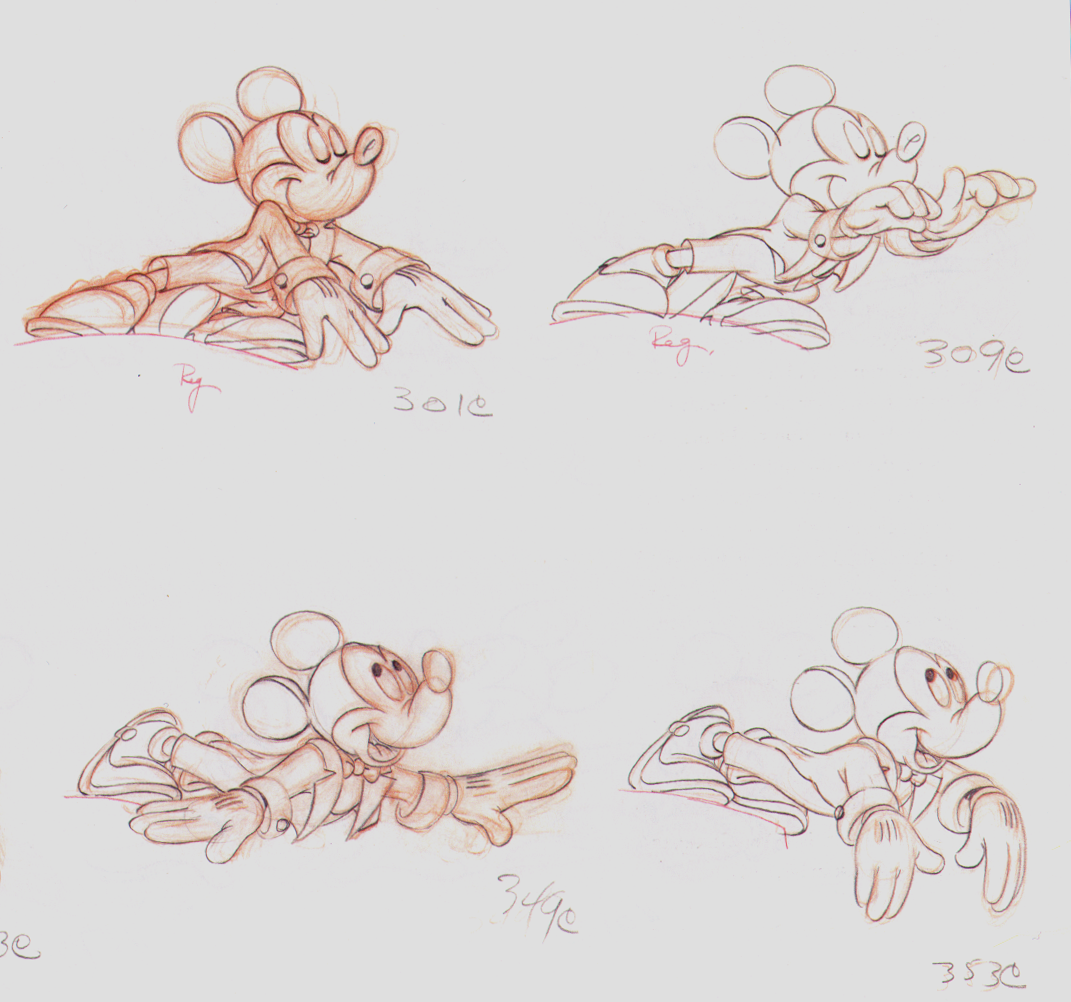
A Woolie Reitherman drawing from the El Gaucho Goofy segment of Saludos Amigos, 1943. Note the use of multiple colors of pencil.  Note also this amazing action drawing by Woolie!


Though not the only good animators at the studio, the Nine were all excellent, they had the all-important support and respect of Walt Disney, himself, and they got the cream of the important scenes to animate.  Eventually they mostly became supervising animators, mentoring younger animators such as Andreas Deja, Glen Keane, and many others who were to succeed them when they retired.

Two frames of Smee from Peter Pan, by Ollie Johnston, who was known for his light touch, sensitive emotional interpretations, and speed.  Johnston is the other co-author of Illusion of Life.


Deja has the advantage over other Disney historians in that he lived the life, producing in his own right numerous memorable animated performances such as villains Gaston, Scar and Jafar, and the comic hero Hercules. His insights about these men and their work are keen, and his own unflagging enthusiasm for his subject shines through.

Somewhat amazing is the wide variety of personalities and temperaments among these men who, nevertheless, were all able to sit and perform these feats of acting and creation at their drawing desks. Several, despite their differences, had the discipline and versatility to follow each other's lead in design and animation on a character, so that they could provide sequences of their own that integrated seamlessly with the other man's work.

John Lounsbery could even capture the style of Milt Kahl, and he could define his own characters, too.  Here, John's character Ali Gator, from the Dance of the Hours sequence of Fantasia, 1941.

Ward Kimball managed to get through his Disney career without once having to animate a realistic character like a prince or princess.  He liked it that way, but he was amazingly innovative both as a designer and in staging his scenes.  Here are some wonderful Kimball roughs from the Peter and the Wolf segment of Make Mine Music, 1946. 

Milt Kahl, because of his wonderful draftsmanship, did more princes  than anyone, but he enjoyed the cartoony stuff as well.  Here is the eponymous star of Pinocchio, 1940, as he finds himself turning into a donkey on Pleasure Island.


Marc Davis, creator of Flower the skunk in Bambi, 1942, and two immortal female villains, Maleficent in Sleeping Beauty, 1959, and, shown here, Cruella DeVil from 101 Dalmations, 1961. Davis then became a principal designer for attractions at the Disney theme parks.

Any student or practitioner of 2D animation should certainly have this book for both inspiration and study, and 3D animators and designers could also learn from it.  These are the very men who discovered and perfected what are now known as the 12 Principles of Animation.  The Nine Old Men are all gone now, but they have much yet to teach us.

All images copyright Disney.
Wednesday, November 11, 2015

No. 80, Why I Sometimes Don't Post Regularly

Writer's Blog


Whenever I fail to post to this blog over a period of weeks or months, you can be sure there is a good reason for it.  It will not be because I am bored with it, or that I am burnt out or have run out of material and ideas to blog about, or that I don't care.  I recognize the value in posting regularly, and I try to do that as much as possible.  Failing to post can result in lost followers and other readers.

If I don't post new material, it will be due to a serious cause, like ill health or death. Or, best of all from my point of view, because I am working. The period between May and November of 2015 was just such a case, where animation and design that I was doing for a game went into crunch mode and I was putting in more than 40 hours a week on it.

My blog is not only commentary.  It often involves adaptation or creation of visual images specially for the blog, which takes time. A lot of thought and preparation go into each posting, because I want to be lucid and engaging and often instructive all at the same time.

If I have full-time work with deadlines, that takes away both from my blogging time and also from the energy needed to do justice to my blog.

So whenever I fail to post for a while, please don't give up on me.  I'll return and probably pick up where I left off.

Thank you for your loyalty.  I will continue to try to give you something new to think about each week or so.

--Jim Bradrick

Sunday, February 22, 2015

No. 77, Blurring the Pencil Lines: 2D Animation in Today's Independent Films

As digital animation technology matures and disseminates down even to one-person studios like my own, the distinction between 2D and 3D animation becomes less clear--less easy to sort into just two piles and often less easy to identify in viewing.

A film may be animated on paper, then scanned in and completed digitally.  A very similar looking film may be animated directly into digital form, by using an electronic stylus and a Wacom or other tablet, but still adhering to the traditional process of superimposition of images for registration and then either animating straight ahead or by the more controlled method of extremes, breakdowns and inbetweens.

A traditional 2D film can be processed and enhanced digitally to the point that it greatly resembles something done with 3D models in Maya or another similar 3D program. Conversely, a film animated with CGI models can now be rendered to look like it was animated on paper. Then there is the increasingly dominant TV production method of 2D digital puppetry. And there are now numerous examples of hybrid productions, where some elements are singled out to be created as CGI models while others are still done in 2D, the output of both being blended in the production.

But just for fun, let's see what traditional 2D elements we can discern in the nine Oscar contender films I listed last week.

The Plainly 2D

Bus Story

Duet

Footprints

Me and my Moulton

The most obviously and directly 2D are Bus Story, Duet, Me and my Moulton and Footprints. They all show signs of having been animated on paper.  In Bus Story, Duet and Footprints, one can even see the character of pencil lines in the final render, although I wouldn't be too surprised to learn than someone has developed some automatic and logarithmic way to convincingly duplicate even that look.


Me and my Moulton looks inked in the same way that hand-traced cels used to look inked, but I would bet that this was all done in a computer.

The 2D, 3D Hybrids
The Dam Keeper
An interesting crossover is The Dam Keeper, with a final render style that looks like impasto paints applied with a large chiseled brush. And I rather thought that the characters were CGI modeled. According to online information, however, the drawings were on paper and the painting was digital.  I do think I saw some CGI images here and there, as with the tramcar and the mill interior.

Even with the Disney funded Feast,  I am not sure there is anything done on paper beyond the concept stage. But I have not found anyway production details about this film.  Anyone out there know?
The Unabashedly 3D
Of the three remaining, I feel certain that two are straightforward CGI model productions: A SingleLife and Sweet Cocoon, though the former has opted for a look that is somewhat in the clay animation style of a Nick Park.
A Single Life

Sweet Cocoon


And a Big Hand for Stop Motion
Last, and in many ways most interesting of the whole group, is the extraordinary stop motion film The Bigger Picture.  It is extraordinary in its intended audience, which is emphatically adult; it its scale, which is actual size (a character who is intended to represent a six foot man is actually six feet tall in from of the camera); in its variety of media, including wet, opaque paint on a wall and other flat surfaces, papier maché and real furniture and rooms as props and settings.
The Bigger Picture


So there you are.  But just now, as I type this, it is 5:06pm, Pacific Time, and that's time to go watch the Oscars presentations and see who wins!

Tuesday, February 3, 2015

No. 76, Animated Short Subjects Oscar Contenders 2015

Today I got a chance to go and see all 5 nominees that made the final cut for Oscar contention in the Animated Short Subject category, plus 4 runners-up.  Let's take a look at what we have here.

The Five Nominees


Me and my Moulton.  14 minutes. Director: Toril Kove. Canada.

2D animation with possible computer assist.  Simple and charming line art about 3 daughters of eccentric Norwegian parents, narrated by the middle girl.

Feast. 6 minutes. USA.

From Disney, a digital film directed by Patrick Osborne about a foodie dog and his foodie owner.  Clever and full of life, with an unusual lighting treatment that is high contrast and sharp edged. Typical Disney character design and movement.

A Single Life. 2 minutes. Netherlands. Directors: Marieke Blaauw, Joris Oprins, Job Roggeveen.

The shortest by far of these short films, this is a succinct and quite funny digital film with a character design based on stop motion clay animation.  My pick to win.

The Dam Keeper. 18 minutes.  USA. Directors: Robert Kondo and Dice Tsutsumi.

A perplexing digital film with a flawed storyline about an orphan pig who is both a bullied child in school and an adult burdened with an onerous responsibility for his whole town. The rendering style is painterly and ragged with some quite beautiful color design.

The Bigger Picture. 17 minutes. UK. Director: Daisy Jacobs.


An unusual stop motion film in a combination of kinetic painting and papier maché animation, about two grown men and their elderly mother.  Touching and funny and strange.

The Four Also-Rans

No explanation is given for the selection of these four films which have been included to be distributed with the five nominees.  Whether they were jury favorites or just easily available is not mentioned. Nevertheless, here they are.

Sweet Cocoon. 6 minutes. France.

Hilarious and well-animated digital film about an overweight caterpillar who gets help in getting into her ready-made coccoon  from two elderly beetles.

Footprints. 4 minutes. USA.

2D animation in the unique and highly personal style of Bill Plympton, whom I applaud for making a go of 2D animation while personally not liking his work very much.

Bus Story. 11 minutes. Canada.

2D animation in a primitive style reminiscent of Richard Condie, this film sponsored by the National Film Board of Canada tells the story of a woman whose modest dream is to drive a school bus.

Duet. 4 minutes. USA.

A film by the Disney-trained virtuoso 2D animator Glen Keane, about a boy and girl growing up from babyhood and finally and inevitably coming together as a couple.


Next: Blurring the Pencil Lines: Traditional 2D Animation in 2015 Oscar Entries

Monday, January 26, 2015

No. 75, Me vs Toonboom StoryBoard Pro, Part Four

A Note to My Readers:

The internet is littered with the corpses of abandoned blogs, their authors having lost interest, become burnt-out or otherwise permanently diverted.  This is not one of them.  I have taken a long hiatus caused by a combination of things: a trip to Italy, some paid work that has kept me busy, and a couple of hangups with StoryBoard Pro that I will mention below, but I have not lost my enthusiasm for my little cause of learning and writing about animation.

I realize the value of posting regularly, and am back with the determination to regain your attention and interest.  I thank you for your past allegiance and intend to carry on now as before. Let us continue.

-Jim Bradrick


Trouble in StoryBoard Pro


Digital vs Paper

I made a valiant effort to do my storyboards digitally, but this has not proved easy for me.  This is perhaps the most significant thing that got me stalled last August.  I can do it, and if you took away all my paper and pencils, I would do it, just as I would certainly learn to draw again with my left hand if I lost my right.  Nevertheless, it still feels more comfortable to me to draw on paper, and so, for now, I have gone back to doing first-draft sketches on paper and scanning them into the computer. As I am the animator as well as the storyboard man on my own projects, these sketches often double as my animator's thumbnails, and when I have just a pencil in my hand I am not distracted by having to deal with such issues as layers, toolbars and keyboard shortcuts that cut into my creative line of thought.

Written down, these things seem less like good reasons than mere excuses, and I am sure I will get over my discomfort eventually, but my decision to return to paper and pencil allows me to move forward again, and that is the important thing.

Sound

Then there is the issue of sound.  My script for The Two Washingtons contains dialog, and as I approached the dialog sequences I found that I was having trouble with visualizing the complex character interplay that was to go on.  There are four character voices planned, with possibly a fifth, and I realized finally that I ought to go ahead and record a scratch track so that I could work out dialog timing. Other dynamics between the characters would also become apparent.

If you have ever priced professional sound recording equipment, you know that this can be expensive.  But my friend Don Wallace of Wallace Creative in Portland, Oregon, put me onto a solution that gives me high sound recording quality at an amazingly modest price.  This solution is the Zoom H1 Handy Recorder. Powered by just one AA battery, it gives you digital sound recording you may find hard to believe.

The ZOOM H1 recorder on its mini tripod and with a foam wind baffle covering the mic.

Armed with my script and a fondness for ham acting, I soon had the soundtrack I needed.  In Adobe Soundbooth I edited the track into clips, changed the pitch on the voice of one character, and imported the sound into SBP.  As expected, having the dialog sound on the SBP timeline helped greatly in timing the remainder of the storyboard.

In the timeline at bottom, note the sound clip showing in waveform mode.


Thursday, September 11, 2014

No. 74, Rare Animation Books: The Animated Film

The Animated Film, by Roger Manvell, pub. 1954 by Sylvan Press. 63 pages.


This book, subtitled "with pictures from the film 'Animal Farm' by Halas and Barchelor", was remarkable in its day for not being about the Walt Disney studio.  Indeed, it was about a British studio and their production of the first British feature-length animated film.  Across the pond at Disney, work was going forth on Lady and the Tramp, another sentimental adventure with songs that had become a Disney mainstay.  Animal Farm was nothing of the sort.

The film was based on a popular book of the same name by George Orwell, who was a journalist and, later on, author of the  more famous dystopian novel 1984. The book was a satire of the communist form of government and, more specifically, of the Soviet version of communism, which in its heavy handed way had become in many ways indistinguishable from fascism.  It told the story of farm animals who rise up and overthrow their human master and then attempt to govern themselves, with the more cunning and ruthless among them eventually rising to the top.  "All animals are equal," goes the famous quote, "but some are more equal than others."

Expressive animation of the pig who decided he was "more equal than others."


Two still frames in black and white from the color film Animal Farm.


Today it is known that the CIA, interested in any kind of anti-Soviet propaganda, obtained the film rights to Animal Farm, and that under the direction of Howard Hunt (of Watergate infamy) the producer Louis De Rochement was chosen as front man.  De Rochemont then selected the Halas and Batchelor studio to create the film. It is not generally believed that the studio had knowledge of the source of their funding at the time.

The Halas and Batchelor workflow chart of animation production.


The film was remarkable for being of adult interest rather than that of children.  John Halas, a Hungarian immigrant to England, and his wife and partner, Joy Batchelor, expanded their studio to a staff of 70 for the production. Three years, from 1951 to 1954, were spent in the making of the film. The technique and style chosen were not unlike the Disney model, with drawn animation traced and painted onto cels, and with care taken to achieve a certain amount of realism in the movement and design, again in the mode of Disney.  It was, after all, intended to be released as a commercial product, so it needed to be able to compete.

A page showing development of the design for one of the human characters in the film.

Model sheets of some of the animal characters.


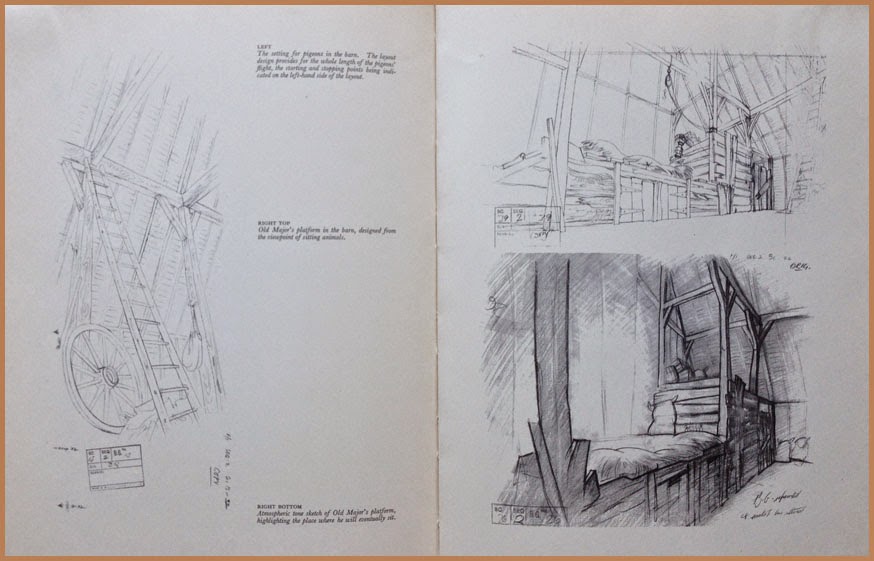
The book includes expressive model sheets of the characters, sections of storyboard, layouts and animation drawings.

A detail of the Tension Chart.


An interesting insert is a foldout "Tension Chart" showing the flow of tension or excitement from beginning to end, including notes on mood, music and color.

Background layouts.


But although the film was in color, the books illustrations are all in black and white.  Altogether it is a fascinating look through a parallax lens of feature animation production in a country other than the US.

Views of production work around the Halas and Batchelor studios.


Roger Manvell, the author, was a writer who had worked for years with Halas and Batchelor "as a researcher, author and screenwriter", according to the 2006 book Halas and Batchelor Cartoons, An Animated History, by Vivien Halas and others.  In addition to The Animated Film, he also wrote in association with John Halas three other books on animation.

The Animated Film is out of print and likely to be very difficult to obtain.