Pages

For People Crazy About 2D Animation!

Acme Punched! is for people crazy about 2D animation. It may be enjoyed by beginners and others, but it is aimed at animators who know already something about the process of animation and the basics of character animation. In large part, it will attempt to provide a deep look into the problem solving that goes on in my head as I work out a scene, often in step-by-step posts that I will sometimes enter in "real time", without knowing in advance what the outcome will be. Mistakes and false starts will not only be included but emphasized, so that the creative process of animation will be portrayed realistically. And, while my own bias is for 2D drawn animation, many of the effects and principles discussed here can apply to CGI 3D animation as well. I hope the blog will prove useful and instructive for all.

-Jim Bradrick

Monday, January 13, 2014

No. 54, Jim on a Limb: One (Part 7)

Here is a composite pencil test of a section--the most complicated section-- of this scene on which I have been working for the past few weeks.


I wish I could display it better but there is a limit to the number of layers you can effectively include in a single test, especially using blue pencil, as I do, for my roughs.  So, here and there I have turned some layers off to make it work.  (At times there are seven layers working!)  But you can see all the interaction going on among the woman, the man and the fox.

Not included are some character eyeblinks, which I will create during the inking process in Animate Pro, and the animation of the fox's tail.

I am at last satisfied with this difficult action, directing the viewer's attention in turn to each character as needed.

[For the whole story, see parts 1 through 6 of this 7-part post, which is also designated by the post numbers 42, 44, 45, 48, 49, 50 and 54, and which goes back all the way to June 17. ]

Tuesday, December 31, 2013

No. 53, In Memoriam: Frédéric Back, 1924-2013.


Frédéric Back


This week saw the passing of the great animator and designer Frédéric Back.  German by birth, he became a naturalized Canadian and resided in Montreal, where he created a number of short personal films under the aegis of Société Radio Canada.  (I had previously written that he did his work for the National Film Board of Canada, but in fact he never did.)

I first became familiar with his work in the 1970s, but at his death I realized I had seen only two of his nine films: The Man Who Planted Trees and Crac! Yet those two were enough proof for me of his excellence as a maker of 2D animated films.


The Man Who Planted Trees is based on a true story and also reflects Back's own personal life experience as a conservationist and arborist.

Crac! is a Quebecan family history told around the image of a hand-made rocking chair that becomes a family heirloom.

Both films are magical journeys full of music and transient animated imagery.  And always, the drawing is there, never hidden or disguised; one is invited to enjoy it as drawing even as it moves and transforms as cinema, as storytelling.  Back's films are 2D drawn animation at its best.

These two films and others (though not all) are available for viewing on YouTube and Vimeo, and I challenge you to a minor New Year's resolution to watch and enjoy them along with me.

And now, Happy New Year to my friends and readers around the world!

Tuesday, December 10, 2013

No. 52, Supporting 2D Animation

Draw-4-2D


If you haven't heard about Tony White's 2-D Liberation Movement and the associated Draw-4-2D project, let me fill you in.  Tony White is an award-winning animator, author of animation books and teacher of animation who for years has been trying in various ways to spotlight 2D animation as a dying art and craft, and to stimulate a revival.  Tony points out that whereas 2D animation once flourished in the US, now it has all but died out in theatrical production, while in Europe and Asia 2D films are still being created and enjoyed.  American distributors seldom show any interest in these works.

The Draw-4-2D project is to solicit drawings to be contributed by at least a hundred artists from around the world, plus written statements of support and inspiration, to be published as a book.  The artwork may also appear in a gallery presentation at a future date.

As a fervent advocate of the preservation and continuance of 2D animation myself, it was my pleasure to contribute a drawing for this effort.

My contribution to Draw-4-2D.
 Please check out Tony's website, 2-D Liberation Movement, here, click on Blog, and consider supporting him by sending in your own drawing.


Monday, November 25, 2013

No. 51, Hollywood Cartoons: One's or Two's; Which Works Best?

Sometimes I like to load a DVD of classic cartoons into my laptop and step through parts of the animation, frame-by-frame.  This way you can learn something about the thinking and strategy of the animator and often pick up a few of his tricks.

The other day I was doing this with Bugs Bunny Rides Again, the 1947 cartoon directed by Friz Freleng.  This was the second appearance of Yosemite Sam, and the credited animators are Ken Champin, Virgil Ross, Gerry Chiniquy and Manny Perez.

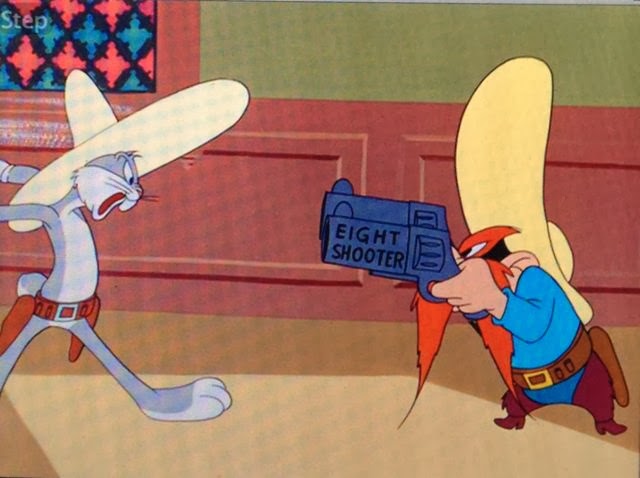
The big showdown between Bugs and Sam (six-shooter, seven-shooter, eight-shooter, nine-shooter, ten-shooter, pea-shooter) contained a surprise and a puzzle when viewed frame-by-frame: the animation of the quick draw action for Sam was mostly on two's; for Bugs, it was mostly on one's.

If you are not familiar with this terminology, here is a little explanation: it was generally held even at Disney that most action could be presented smoothly enough on two's--that is, two frames of film exposed for each drawing in film that ran at a projection speed of 24 frames per second.  So, for one second of action, you might need only 12 drawings instead of 24.

However, for very fast action, and especially where drawings exposed on two's would not overlap at all  (and overlap helps to smooth out the flow of animation), it was regarded as necessary to have a drawing for every frame of that very fast action.

Thus, an animated sequence could be expected to have sections where the slow bits were on twos and the very fast bits were on one's.

(Another circumstance where it is considered necessary to animate on one's is during a camera pan movement, because since the background is moving on one's, the character has to be doing the same.)

In the showdown between Sam and Bugs, they face each other and draw their two guns alternately.  Here is where I observed a difference in their animation.  It became obvious because this sequence escalates.  Sam has six-shooters; Bugs draws seven-shooters; Sam draws eight-shooters, and so on until Sam draws ten-shooters and Bugs draws a pea shooter.  And the same timing shows up in each instance  (and, yes, the animation is different each time; the studios at this point in animation history seldom engaged in reuse of animation.)

Below are the key frames from just one part of this action, where Sam draws eight-shooters (on two's) and then Bugs draws nine-shooters (on one's).  Let's look at them now, and then I will say more about them.

Start of the action.
Sam drawing one: 1 frame.
Sam drawing two: 1 frame.
Sam drawing three: 1 frame.
Sam drawing four: 1 frame.
Sam drawing five: 2 frames.  Here I skip 2 drawings of 2 frames each which are the anticipation as he grips his holstered guns.

Sam drawing eight: 2 frames.
Sam drawing nine: 2 frames.
Sam drawing ten: 2 frames.
Now it is Bugs' turn to draw.
Bugs drawing one: 1 frame.
Bugs drawing two: 1 frame.  Again, I skip a few frames as Bugs says something, then gets ready to draw his pistols.
Bugs drawing nine: 1 frame.
Bugs drawing ten: 1 frame.
Bugs drawing eleven: 1 frame.
Bugs drawing twelve: 1 frame.
Bugs drawing thirteen: 1 frame.
And they hold on the final drawing.
Studying this frame by frame, I wondered why it was that Bugs' draws were on ones (or 1's; to me it doesn't matter how you write it) and Sam's were on twos.  I even wondered momentarily if a separate animator had drawn each character.

Playing it with sound, everything became clear to me.  The timing is driven by the dialog.  Each character says something like, "Oh, no it don't!", and draws his guns on the last word.  Sam, as voiced by Mel Blanc, draws his words out a bit longer than Bugs, also voiced by Mel Blanc.  The animator was simply hitting accents, and with Bugs he needed fewer frames to get to the accent.

But what an interesting look at the use of 1's and 2's this is.  The actions are quite similar, the difference between use of 1's and use of 2's is, in this case, just about undetectable.  And they both work.  All the usual techniques are here: stretched shapes, dry-brushed speed and motion lines or tracks, and even a one-frame smear when Bugs brings out his pea-shooter (not shown.)

I invite you to look at some animation this way.  Many console  DVD players offer this step forward feature, and the DVD player of my Macbook Pro also works well for this, except that it will not step backwards.

Note: All images in this post are copyright of Warner Brothers Entertainment, Inc., and are used with their imagined indulgence.

Sunday, November 17, 2013

No. 50, Jim on a Limb: One (Part 6)

Animating the scene shown and described in No. 49 was a matter of trial and error.  For the most part, the poses worked and it was just a matter of working out the timing.  For example, the two changes of expression (from despair to determination, then to cunning) were at first almost identical in their timing.  I realized then that coming one right after the other, they needed to be different from each other.
Despair to determination is now shorter in frames, and the hold at the end is also shorter, than both those things in the second transition, from determination to cunning.  The latter thus gets more stress, and fittingly becomes the more important.

Three expressions: despair, determination, cunning.


To view the difference in timing, go here.

One pose that had to be re-done was this one showing her slumped down in despair.  For this character I wanted to use that limp-wristed attitude that at one time was so common among women when their hands were idle, but my first try had produced a pose that did not quite express the despairing mood. 


Also, when I saw the test in animation, I didn't like the movement, which showed the forearms and hands pulling back up too far after dropping down. It did not express the intended attitude of resignation and despair.

I replaced that pose with the one shown below, and I damped the movement until it seemed just right.


But one thing did go as I had hoped, and I got it right first time out.  This is the final movement where she settles into her attitude of supplication; she is saying, "Give me a break!  What did I ever do to you?"  Her arms come up and she knocks her fists together three times, hunching up her shoulders.


When something like this does go right, it makes all the other struggles worthwhile.


Next: Jim on a Limb: One (Part 7)  Doing What Is Necessary

Sunday, November 10, 2013

No. 49, Jim on a Limb: One (Part 5)

Note: I have now numbered all my posts chronologically, in addition to having series and subject headings.  I think this will make it a little easier for me to refer back to previous posts, and for you to locate them, especially as the parts of  series are are not always consecutive.


The Pencil Test


Here is the pencil test of Victoria as promised in my last post.  Remember that the fox has her firmly by the nose throughout this scene.  I have not included that layer of the fox only because using too many layers in a pencil test makes for a dark and murky image that you may have trouble viewiing.

[movie]

It works pretty well now, but as in most complex things that one tries to plan in advance, there were some changes along the way.


Changes to the Plan


First, two new extreme poses were added.  They fall between poses E and F as shown in Part 4.  Here are those poses again, with the new ones placed inbetween.

Pose E
Pose E expresses her feeling of despair.


Pose E-1
The first new pose, call it E-1, shows her stubborn nature returning; she will not be defeated!


Pose E-2
The second new pose, E-2, is a cunning expression; she has an idea and she is calculating whether it will persuade the fox.


Now we go to pose F and then G, where she gathers herself and then adopts an attitude of pleading or supplication.


Pose F

Pose G

Thus we have her thinking her problem through in a way that the viewer can easily follow.  This is the sort of deep exposition that I am just now learning to do, and which I have often failed to understand in the past, largely because my experience in professional animation has been mostly confined to commercials of 30 seconds or less, with no time and frames to spare for looking into a character's motivations and thought process.


In Part 6, I'll talk about how the animation itself went on this little scene.

Next: What Came Easy, and What Was Hard


Friday, October 25, 2013

No. 48, Jim on a Limb: One (Part 4)

Six weeks since I have posted.  Partly it was this and that, an illustration job, a couple of commercial jobs, the re-designing of my website, a busy late summer.  But also it was the difficulty of the problem here--the one I last mentioned in post no. 45, Jim on a Limb: One (Part 3)--in which I laid down the key drawings I needed to animate.  If you want to follow the continuity of this demonstration, please go back now and look at that post.

How It Looks in Pencil Test


Here is the result:

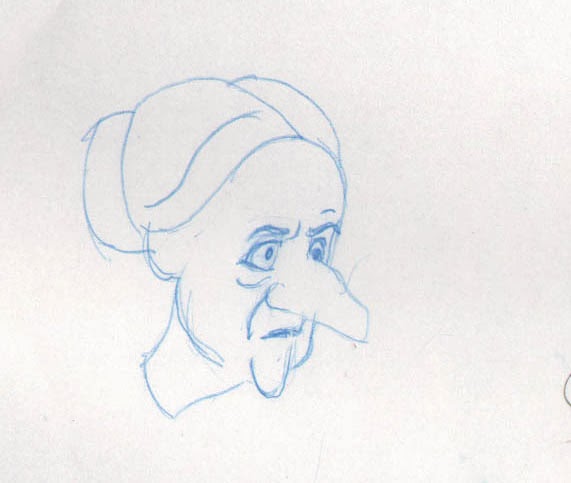
Of course this test is focused on the man.  His name is Albert.  I also have animation of the woman  about ready (her name is Victoria), but because too many layers make the pencil test dark and difficult to follow, I have left off all layers here except for two: Albert, and Albert's Head.

This is about what I wanted it to be in so far as Albert is concerned.  I think you can see him thinking.  He gets serious and cautious at the beginning, he communicates his plan to Victoria, and when he gets bumped in the nose by the fox as he lowers him down, Albert doesn't let it bother him much.  One thing I will make more clear is Albert's expression, which will remain disapproving until, at the end, he relaxes his stern expression to gaze in perplexity at the fox, who is behaving so badly.

Next it is Victoria who will try to deal with the fox, first as if to make some argument, then feeling hopeless, and finally just appealing to his good nature.  And all without a word of dialog or narration.

I have begun by adding a few more key drawings to define Victoria's performance; the first ones would be sufficient for a storyboard, but the animator must go further and think of everything that will be in the character's performance.

Victoria regards the stubborn fox.
Pose A is the last pose of the pencil test above.

She resolves to try something to make the fox let go.


Pose B shows her determination to act.  It also is an anticipation to Pose C.

She moves as if to speak out loud to the fox...
Pose C.  She might be about to actually say, "Why won't you let me go?"

...but stops short, realizing the futility of this.
Pose D pulls back a little from Pose C.  She holds for 16 frames, blinks.

Victoria slumps, feeling the situation as hopeless.
Pose E  expresses her feeling of despair.

An anticipation to pose G.
In Pose F, Victoria gathers herself for one last attempt.

The last pose: with her eyes she pleads for the fox's mercy.
Pose G shows her final supplication as she bats her eyelids and beats her fists together.

This is a tough bit to do because it is designed so that the character can barely move her head; where the fox grips her by the nose is a pivot point and anchor for the whole character, and the animator must work only with her expression, with her arms and hands, and with some cautious movement of her shoulders and body.


Next: Victoria and the Fox: the Pencil Test