Pages

For People Crazy About 2D Animation!

Acme Punched! is for people crazy about 2D animation. It may be enjoyed by beginners and others, but it is aimed at animators who know already something about the process of animation and the basics of character animation. In large part, it will attempt to provide a deep look into the problem solving that goes on in my head as I work out a scene, often in step-by-step posts that I will sometimes enter in "real time", without knowing in advance what the outcome will be. Mistakes and false starts will not only be included but emphasized, so that the creative process of animation will be portrayed realistically. And, while my own bias is for 2D drawn animation, many of the effects and principles discussed here can apply to CGI 3D animation as well. I hope the blog will prove useful and instructive for all.

-Jim Bradrick

Monday, November 21, 2016

No. 114, The Character on the Cutting Room Floor

A frame of sequence 7 in Storyboard Pro.
Having now created animatics of four of the sequences for my film Carry On, I am getting some idea of the length of the entire production. Right now, the screen time is something like 6.5 minutes.

For an independent production coming out of a one-man shop, this is an alarming amount of footage. It is not impossible, but with two more sequences still to be storyboarded, it could become overwhelming.  So I am naturally looking for ways to trim unnecessary shots and otherwise tighten up the production.

Every scene is being scrutinized.  What does it add to the telling of the story? What would be the effect of leaving it out? If important, could it be cleverly combined with something else so that the result would be shorter?

Sequence 7 is a case in point. At one minute and twenty-two seconds, it is actually paced rather nicely. But as I began work on the next sequence, number 8, I began to see a problem with them both. The two airline employee characters from 7 appear again in 8, and the interaction between them becomes complicated and time-consuming.  At last I saw that if I rewrote their whole interaction, I could reduce their screen time considerably, while still putting across the same necessary points about their relationship that are essential to the plot. And somehow it seemed now to work better that the senior airline agent should be a man rather than a woman.

It looks as if sequence 7 will now end at about the same length as before, but sequence 8 will be shorter than it would have been, so that the story will become more concise as desired. In addition, the exposition is more clear, and the production benefits all around.

As for the character of the woman airline agent, she is out.  She is, as film makers used to say, on the cutting room floor, like a length of 35mm footage containing her entire screen time, discarded by a film editor.  But of course in animation, editing is virtually always done now, in storyboarding, and not after the film is shot.

Here is what she looks like, together with an image of her replacement:

A promising character design, I will keep her under contract until the right role comes along.
The new guy.


Sunday, November 13, 2016

No. 113, Take Two

After my post about extra drawings in the storyboard (No. 111, When the Storyboard Artist Is Also the Animator) I found myself continuing to work in real time with those drawings, and I decided I wasn't entirely happy with them.  Sometimes you have to tell yourself to let something go so you can get on to the end, but in storyboarding, if it isn't right, it must be fixed. If a pose or a gesture or a camera angle isn't right, you may not be telling the story in the clearest way; you may not be connecting with the viewer.  To ignore the opportunity to improve things in storyboarding is foolish, because this is the last stage when changes can me made cheaply; as experienced animation film makers know, changes in the animation stage or after can be disastrously expensive.

During storyboarding, you actually have the luxury of what a live action director would just call a second or third take.  You can say to your character, in effect, "Let me see you do that again, and this time get it more this way or that way." You thus direct the character: you draw it over and see if you can make it better.

Of course, this extends my metaphor that the independent animator is the director, and the animator, and the storyboard artist, and the inbetweener, and just about every other role in production.  In this case, you are the director talking to the actor (you again) about the character (you yet again.)

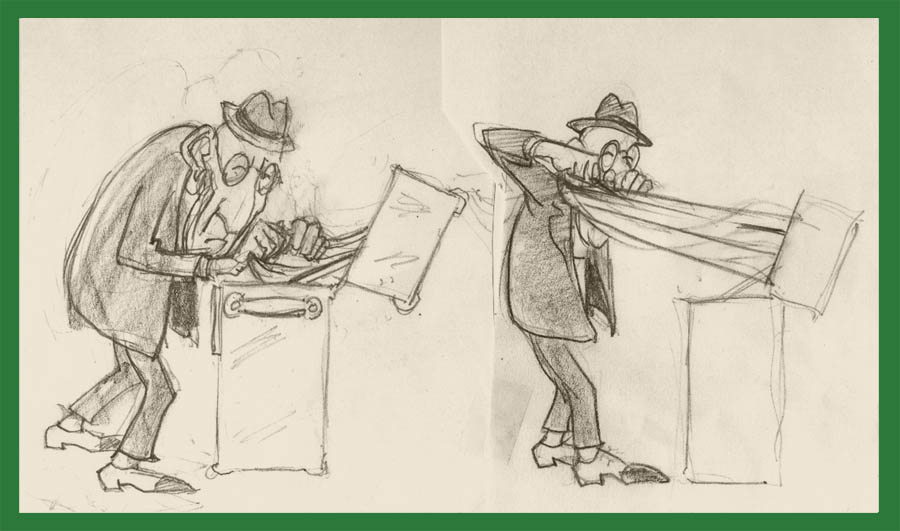
The example I will show you here is at the climax of a whole sequence, when the Old Man reveals the overcoat that he has pulled out of his trunk. Here is the first "take" of that shot, in two storyboard panels.

Having failed to tug the garment out with just one hand, the Old Man gets a good
two-handed grip (image 1) and pulls hard (image 2).
I found these poses to be wimpy and not sufficiently dramatic. So I spoke quietly with the Old Man (in my head) and then I had him do a second "take."

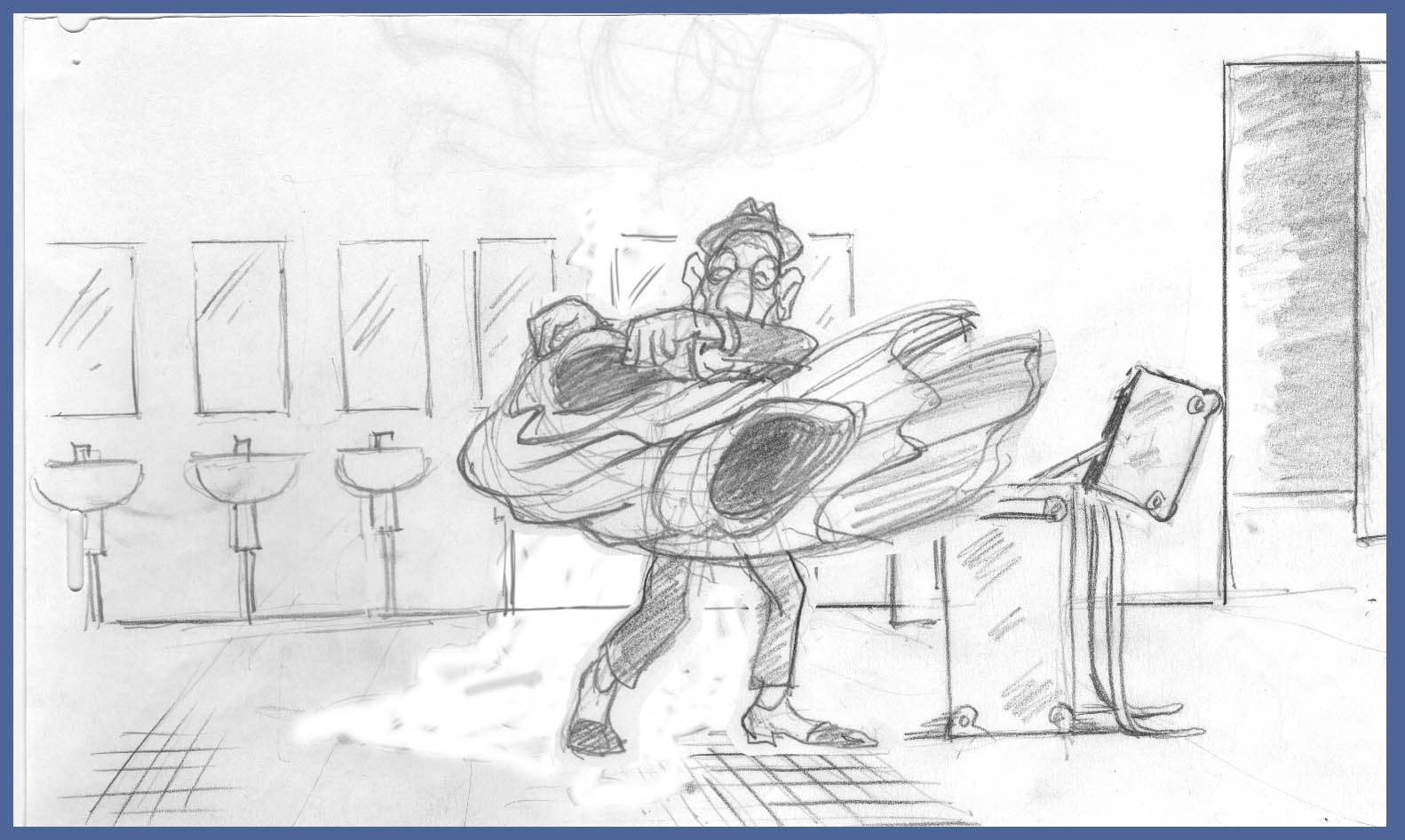
Now as he gets his grip, the Old Man is a more interesting silhouette, and he is
coiled like a spring (image 1). This time when he pulls hard (image 2), his torso twists,
the violent motion throws him out of balance, and he will clearly have to take
a step or two backward if he is not to fall down.
Importantly for the animation, there is now more change between the first and second poses.

I want to note that it is interesting to work with a character like this who has some physical limitations and therefore cannot perform all the vigorous variety of moves of a younger character who is in good shape; his back must always be bent, and any violent movement may cause him to lose his balance or even hurt himself. Mostly, though still strong, he must move slowly and with caution.

I have gotten very fond of this old gentleman, and I look forward to doing him justice when I get into the animation.


Saturday, October 22, 2016

No. 112, Richard Williams Teaches Me How to Draw Urinals

On my storyboard, I find myself still in the men's room--in the toilet.  And faced with the challenge of drawing a long neat row of urinals in perspective, I soon turned to the renowned animator and designer Richard Williams.

It was not the urinal itself that was the problem, but the convincing rendering of a series of evenly spaced modules diminishing in the distance.  It is easy to know the size at any point along the row by the perspective lines radiating from the vanishing point, but it is not so easy to know where they should be placed along those lines.

In a lot of things, the experienced artist can fake perspective without going to the trouble of establishing an actual vanishing point and then drawing guidelines. Or perhaps a phrase more accurate than the word fake would be "make an educated guess." If the situation is simple enough, one can often get away with it.

But with things as regular as fenceposts or Doric columns, the viewer will be quick to notice if something is wrong in the spacing.  After only a little drawing and a lot of erasing, I remembered that Richard Williams had addressed this issue in his book The Animator's Survival Kit. It was certainly worth looking up.

This is actually about spacing the drawings of something moving toward you in perspective,
but it also applies to a series of evenly spaced objects in perspective.
A most useful trick to know!
So here is how I applied it to my row of nine urinals.
You can see some of my blue pencil intersections.
What this doesn't give you is any cumulative change in angle as you go down the line. That part, I did fake.

And now here are the urinals again, this time with customers.


And all of this for a shot that will be on screen for less than two seconds. My thanks to Richard Williams, and to the great Warner's animator Ken Harris, who showed him this trick.

Saturday, October 15, 2016

No. 111, When the Storyboard Artist Is Also the Animator...

When the storyboard artist happens also to be the animator, some things may be included in the storyboard that would not otherwise be.


In my case, as an independent film maker, I am just about everything else in the production pipeline, too--but never mind about that.

 When I am the Storyboard Person and I come to a scene where my thinking is engaged in the development of a scene, sometimes the Animator takes the pencil away from me and adds some "unnecessary" panels to the board.

Of course they are not entirely unnecessary--not at all.  But they are perhaps not necessary to the storyboard as such; they are instead necessary as thumbnails for the animator. Thumbnailing your animation ideas is considered an essential step for the animator in visualizing all the action of a scene before more detailed work is begun.

I do consider not including these more subtle stages of movement, but when I do, the Animator jumps to his feet in great agitation, saying, "Wait! Having thought of these details, how can you not set them down?  What if, by the time I, the Animator, at last get hold of the scene, I do not recall these inspirations that have occurred to us, and instead do something with the movement of this character that is less interesting than what we have thought of here? Then, having not recorded these fleetiing but wonderful notions, they will be lost."

And so I find that I, the Storyboard Person (Storyboardist? Why is there not a one-word term for this art? Even Inbetweener, awkward though it is, is but a single word) cannot argue with the Animator in this. If you think it, if you like it, write it down or draw it; make a note of it.  Because, you see, if you think of it and do not record it, and then you forget the thought that you had, you may even forget that you had any idea at all.  You will not even know that anything is missing. Why take that chance?

Following is a part of a scene that might have been depicted satisfactorily in just five panels, storyboard-wise. But for the sake of the Animator, I (the Storyboard Person) have included some extra stages of movement.

The first panel, the first pose.

He pushes open the lid; an essential panel.
Reaching into the lid; another essential panel.
In this panel and the next, the man unsuccessfully tries to pull something out
of the lid, This might be something that the animator and not the storyboard
person would be adding.
The Old Man now takes a two-handed grip.
This drawing clearly could be omitted from the storyboard, if not from the
notes of the animator.
This panel is another essential, showing the flow of the big overcoat as it
emerges from the lid of the trunk.
Another panel not essential to the storyboard. One can easily get the whole
idea of the action without these two sepia-colored panels.
The final essential panel.
Yes, we could easily have met the requirements of the storyboard with only seven of these nine images, and perhaps with only five.  And yet, having visualized the action, why not note it down? In my opinion, storyboard artists should always err on the side of excess rather than omitting that which might prove to be useful and evocative.

Tuesday, October 11, 2016

No. 110, Welcome Recognition

In the Top 100


Today I was pleased to be notified by Anuj Agarwal, founder of Feedspot, that this blog has made their newly revised list of Top 100 Animation Blogs. (See the badge displayed at the top of my sidebar.)


This means a lot to me, as I am one whose target audience is restricted somewhat to people interested in pursuing 2D animation--admittedly, a small group even world-wide--as opposed to that of someone writing about animation news or animation in general.  Also, with some exceptions such as book reviews, I restrict the content to accounts of my own personal experiences in animation.

Nevertheless, I expect that there will be many new people looking in on this blog now, so I am determined to keep posting tips and personal accounts that are as interesting as I can make them. Therefore,  both to the loyal followers I already have and to anyone new, please keep coming back for more.

Wednesday, September 28, 2016

No. 109, Fun in the Men's Room

In my film Carry On, now in production at the storyboard and animatic stage, the main character, an Old Man trying to get a large trunk aboard an airliner as carry-on luggage, has to make a wardrobe change. Dragging the trunk into one of the public men's rooms at the airport, he proceeds to open the trunk to get at his clothing.

As I thought about the situation, I realized there was a possibility here for some comic business in the background.

The Old Man, intent on what he is doing, is oblivious of all else around him, but unwittingly he is disturbing the other men in the large restroom.

I knew right away I didn't want to do any gags about farting or anything else scatological, but I did see that I could make something out of the vague discomfort and wariness that many men feel when in a public restroom.

Following are a few drawings showing the development of this short scene. Some of them may not make the final cut, but they illustrate the storyboard artist's exploration of potential comic elements.

First shot.
We see the big trunk being dragged into the men's room. No need to
animate the Old Man here!

Next, a shot of a men's room user, vacantly staring at the wall.  It is
obvious what he is doing.
Go to close up.
Unusual noises wake him up. (The viewer has already heard
these same noises before: it is the Old Man opening the buckles
and catches of his big suitcase.)
He tries to see without turning his head, but...
...in the end he must turn his head.
Wide shot of the room. The Old Man is about to open his case.
Another man gets curious.
With a flourish, the Old Man whips out a heavy overcoat from the open case, startling a man about to leave the restroom.

Some of these images are not final storyboard panels, but I am well on my way to locking this section of storyboard down into precise camera shots and angles.

I'm having fun in the men's room.  How about you?

Sunday, September 18, 2016

No. 108, The Later Books of Preston Blair

"How to Animate Film Cartoons"


In 1980, a second title by Preston Blair appeared from Walter Foster publishing in the same format of large pages as his first one.  This was called How to Animate Film Cartoons, and it included a great deal more in the way of technical tips and tricks for animators than the first one had.

Preston Blair's second, and more in-depth, animation book.


The year 1980 also saw the publication of the amazing Illusion of Life, the huge and comprehensive tome written by Frank Thomas and Ollie Johnston of the Walt Disney studios.  The year marks the beginning of a surge in book publishing of more serious and in-depth treatments of the animation business and its art and technical aspects.

Preston Blair, veteran of both Disney and MGM cartoons, was in 1980 as ready and able as anyone to provide his own version of this animation insider's lore. Want to know the difference between pose-to-pose and straight ahead animation? Blair can now tell us all about it, and in fact he covers this particular subject in a way that is more clear than the explanations of Thomas and Johnston.

Preston Blair's explanation of poses with extremes, and...

...his demonstration of straight ahead animation.


How about the subject of timing? This all important topic now gets as thorough a treatment in Blair's second book as it was utterly lacking in his first.

How Blair explains secondary actions.


The subject of dialog animation, for which I excoriated him in my review of his earlier work (Post no. 106), now gets the detailed attention it deserves, and so do many of the so-called 12 principles of animation that were first developed and identified at Disney's. Regrettably,  the overly-exaggerated page I criticized is included as well.

A more useful page on dialog animation than in Blair's first book.

In the decades intervening between the publication of the two books, Blair had gone on to become an independent producer of animation, and so he includes information not just about animation itself but also about layout, camera, and the techniques of television limited animation.

In all, the tone is more serious, the explanations more in-depth, and, I think, the expectation of being understood is much higher.  Preston Blair, and others, had discovered a small but avid audience.

"Cartoon Animation"

This book contains all the content of the first two, and more.

The other important publication authored by Blair was the book from 1994 called Cartoon Animation. Still under the Walter Foster imprint, this book measured a much smaller 10 1/4" x 9" but with a hefty 224 pages that included all the material from the first two books rearranged. The only new material was some additional character designs, a few more examples of rough animation from his Hollywood work, and sections on storyboarding and making a finished animation cel, a process that with digitization was soon to become obsolete.

A sample of Blair's outlook on storyboarding.


The main value of this book over the others is its compact format, combining the older books into one handy volume. It is still available and I recommend it for every animator's library.